

Dear readers, I would like to thank all of you for your comments, some of them so friendly. I'm very sorry I haven't posted in such a long time. I am going through a difficult period of my life and I'm not 100% sure about when I'll be able to post again. Maybe it'll be tomorrow, maybe in a month. I hope you won't mind that the Fresh Produce of the Month - Orange will not be exactly in season when I'll post about it.. I will post the roundup, though, sooner or later. :) I won't be gone forever, please keep coming back every once in a while. :)
Take care all of you.
Saturday, March 15, 2008
| [+/-] |
Pausa |
Monday, February 25, 2008
| [+/-] |
Insalata di arance |
The 'Fresh Produce of the Month' event that I host myself is themed on oranges this month (as a reminder, the deadline for participation is March 2nd!) I love oranges by themselves as a fruit. I found it amazing that such a wonderful, juicy and colorful fruit peaks in season in wintertime, when everything is kind of dark, and most of the fresh produce is earth-colored..
So I wanted to celebrate this fruit with a dish that just shows it in its delicious beauty. I remember that when I was a child, my grandma used to make every once in a while a super simple orange salad. She would simply slice oranges and add olive oil and salt on them. So here is my slightly modified version of it..
Insalata di arance / Orange salad
Making it is the easiest thing in the world: slice oranges, juicy and sweet ones, and then sprinkle with pieces of raw sweet onions, black olives and parseley. Season with olive oil and salt. It's really delicious, if you've never had it, you should try it. I found out it's also a typical Turkish food (there was a very similar version on the Turkish cookbook I used recently).
I think this entry could also be a good one for the 'Waiter, there's something in my...' event, themed on 'seasonal salads' this month.. there's nothing more seasonal than oranges. I'm not sure if they'll be ok with not being greens in it, but.. we'll see. :)
| [+/-] |
Click flour! |
The theme of this month's 'click!' event is flour. Wonderful idea.. and so many possibilities! I really didn't want to miss this event, but I've been too busy recently in order to actually work on taking pictures. So I decided I'd make a collage of pictures I took in the past of my creations. What I'd like to underline by doing this is how amazing is the variety of things that can be made with flour. In the end, I chose to shrink the collage down to two pictures, representing the two most important things that can be made with flour, in my opinion: bread and pasta! You can visit the gallery with the other amazingly beautiful flour-centered pictures here
Wednesday, February 20, 2008
| [+/-] |
Cena turca: salsine e 'ravioletti'! |
Nicola lent me an amazingly pretty Turkish cookbook, and so last week I decided to prepare an all-Turkish dinner. Most of the things that really inspired me were the appetizers: in Turkey there are a lot of interesting so-called 'Meze', which include dips, finger food, and nice little dishes to start the dinner with. If you make enough of them (like I did....), they seem to provide by themselves a wonderful dinner. I loved the dips in particular: so easy to prepare, different in taste, and delicious!
I'll show here a few of them, starting with this delicious walnut and pomegranate dip, which will also be my entry to the 'A fruit a month' event, based on pomegranate!
Salsina di melograno e noci / Pomegranate and walnut dip/Muhammara
'Muhammara' is Arabic in origin, and can be also made with lemon juice instead of pomegranate juice. This recipe and the following ones come from the wonderful book 'The complete book of Turkish cooking', by Ghillie Basan, which I strongly recommend to anyone interested in learning about this great cuisine.
To make this dip, you can either use a mortar and pestle or, if you're lazy like me, a blender. :) Pound/blend roughly one cup of walnuts, 1 garlic clove, and 1 tsp cumin seeds, roasted. Add ~1 slice day old bread, soaked in water, and 2 tsp tomato paste. Add also 1-2 tsp sugar, 1-2 fresh chillies or 1 tsp chili powder and 2 tbsp pomegranate syrup. Instead of buying some premade syrup, I blended one whole pomegranate and added it to the dip.. So my dip looks quite different from the picture in the book, as it is less liquid. Finally, add ~1/2 cup olive oil (I added much less than that), and serve with a decoration of parsley leaves and warm pita bread! I made this dip twice (both times using the whole pomegranate, as I thought it made it really good). The second time I didn't add any hot spices, and it was still delicious!
So this dip goes to Sra at 'When my soup came alive' for the 'A fruit a month' event that she's hosting, themed on pomegranate.. great choice, Sra!
The second dip I'm presenting is based on cheese and yogurt.
Salsina di formaggio e yogurt / Cheese and yogurt dip/Pasa Ezmesi This is even easier than the other dip: just mash a ~9 oz piece of feta cheese or 'Beyaz peynir' (I couldn't find the latter, unfortunately), add ~1-2 tbsp yogurt (I actually added more, as I thought it was too solid otherwise), 1-2 tsp hot paprika, 1 small bunch parseley leaves, finely cut, and salt to taste. Serve with hot pita bread and lemon wedges, to sprinkle on every bite.. Again, this dip was so good that I already made it twice, once hot and once not, with great results in both cases. Not sure why I decorated it with mint instead of parsley.. :)
I prepared a few more delicious dips, but I have no pretty pictures of those. So, instead, I'm going to describe the last meze we had: Manti! I was very excited at the idea of making manti since I first read about it on the blog 'I love Turkish Food'. Recently, also my friend Elif posted about them. I thought of them as a sort of 'ravioli' Turkish style, but after I really looked up the recipe, I found out about a fundamental difference: Mantis are baked! Ravioli are boiled. Also, the dough for Mantis is spread a little thicker than ravioli, and the traditional shapes are a little different, although I'm sure there are many possible others. The filling that was recommended in the book is not a very traditional one (I was told by Elif), but we all thought it was delicious - and it's vegetarian!
Manti ai ceci / Chickpea parcels To make the dough, mix 4 cups flour, 1 tsp salt, 1 egg yolk and 1 whole egg. Add as much water as you need in order to obtain an elastic dough. Knead for ~10 min, and then let it rest for ~ 1 h. Prepare the filling: you'll need to have ~14 oz pre-boiled (better than canned!) chickpeas. Mash them (I had to add water for this), and add 1 tsp cumin seeds, crushed, and 1 tsp red pepper or paprika, and salt to taste. For the sauce, saute one onion and 2 garlic cloves in 1 tbsp olive oil + 1 tbsp butter. Add 1 red chilli, finely cut, 1-2 tsp sugar, and 1-2 tsp dried mint (I added fresh mint instead). Then, stir in 14 oz canned chopped tomatoes, and cook until thick. Adjust with salt and remove from heat. For the yogurt sauce, you'll have to mix ~6 tbsp thick yogurt with 2-3 garlic cloves, crushed.
By the time you're done with all this, one hour should have passed, and you can start making the manti: roll down the dough till very thin (we used a rolling pin), and cut it into small 1" squares. Spoon a little of the chickpea filling, and close the edges forming a litter pyramid: Place the mantis in a buttered oven pan, and bake at 400 F for ~15-20 minutes, till golden. Then, add vegetable stock to it. For this dose of mantis, you should add a total of ~2 1/2 cups stock, so divide it depending on how many pans you made. Cook for another 15-20 minutes, till almost all the broth is adsorbed. Then, serve with yogurt, tomato sauce, and chopped parsley on top.
These mantis are addictive! Elif told me that the dough was right, and also the slightly crunchy consistency of the manti. She never tried the chickpea filling and she really liked it too! So, I was very pleased at this success. To give credit to the right people, I only prepared the sauces and the filling for this - Lucas, Vardha, Filipe and Vlasta did all the rest of the job while I was finishing to prepare the dinner!!! Great job guys!
Sunday, February 17, 2008
| [+/-] |
Canti corali |
One of my passions, other than people, science, and cooking, is music. I recently started going back to sing in a wonderful choir here in Berkeley. It's the choir that sings at the 9.30 Mass at 'Newman Catholic Center'. I'm absolutely amazed by how good this choir is. Some people study music, but most don't, and yet, they can just read a song altogether, and something usually good just comes out. After a few practices, we can sing wonderful pieces. This morning, we sang a song that's amazingly touching... I want to share it, as it's so beautiful. It's 'Sicut Cervus' by Palestrina. I found a video of it on You Tube:
I love how all the voices melt together, coming in at different times, like a wave that moves you towards something higher. The words are in latin, from Psalm 42, v.1, and it's really just a simple sentence: 'Sicut cervus desiderat ad fontem aquarum, ita desiderat anima mea ad te, Deus.' ('As the deer pants for streams of water, so my soul pants for you, O God.')
We'll also sing another wonderful song for Easter, 'Haec Dies', by Byrd. I found this too on YouTube:
This is very happy and a lot of fun to sing (it's for Easter, the day of the Resurrection for Christians). This too is just one simple sentence: 'Haec dies quam fecit Dominus: exultemus et laetemur in eia. Alleluia.' (Psalm 118, 'This is the day the Lord has made; let us rejoice and be glad in it.'). I'm really excited thinking about when we'll be able to sing it as well as this choir!
Friday, February 15, 2008
| [+/-] |
'No-no' per ristoranti Italiani negli States |
I found out about the existence of a 'no-no' list written by an Italian chef for Americans opening Italian restaurants in the USA. It's really funny, so I thought I'd share may comments on this blog..
You can find the complete list here. First of all, I must say I do agree with most of his suggestions, but I think it's really funny the way he gives some of them.. Here are some examples.
'Do not put Caesar Salad on your menu. It is a Tex-mex hybrid not an Italian delicacy, as often Americans believe.' I must say I really agree on this. I was completely surprised when I found out what Caesar salad was in the first 'Italian restaurant' I went to in the USA ('Olive garden'........). I really dislike the huge amount of sauce and the usually bad quality cheese they put on top of completely tasteless lettuce..
'Do not put on the menu “small, medium or large” for pasta portions. Pasta is not a style of underwear.' This cracked me up!!!!!
'Do not serve garlic bread. Instead, you can make a civilised bruschetta but without butter and minced garlic. 'The idea of a 'civilised bruschetta' is also particularly funny.. And I must admit, I love minced garlic and olive oil on toasted bread (no butter) - it may not be the classic bruschetta, but it's a wonderful approximation of it.
'Write the menu in correct Italian. Avoid ridiculous names such as Sophia Loren's Fillet or Tagliatelle alla Pavarotti.' This is definitely a good suggestion..
'Do not put garlic in every dish and avoid serving Parmigiano indiscriminately, with risotto with crustaceous, shellfish and other seafood pasta.' I couldn't agree more on this. Pizza with garlic and parmigiano is definitely a no-no!!!
'Avoid red and white chequered tablecloths and paper serviettes artistically folded or put in the glasses. Avoid garlic or the empty Chianti flask hung on the restaurant's wall. 'Ehehehe, this is also really funny :)
'Avoid serving cappuccino and latte macchiato with dessert as much as you can. 'I find it hilarious the way he suggests this: 'avoid this as much as you can'.... :) I guess if someone really asks for it, you cannot completely refuse. :) But I do agree, ending a meal with cappuccino (or even worse, having cappuccino with your meal) is not Italian style. We have cappuccino for breakfast. Still, I must admit: if someone really wants it, why not?? :)
| [+/-] |
Interessante minestra vietnamita |
When Sunita launched 'Star Anise' as the theme of her 'Think Spice' event, I was really happy. In fact, I bought a little bag with this wonderfully-looking spice, and still didn't get to try it. I had no exact idea about what to do with it. It seems like an anise-tasting spice would go well in a dessert, but it's Lent, and I decided I wouldn't eat desserts for this time of the year (ehm, I'm not that strict, but I didn't want to make one myself, at least, unless there was a really super special occasion). So, looking for savory recipes involving star anise online, I found out that the Vietnamese soup 'Pho' is intensively flavored with this spice. Traditionally, it is made with beef. Still, I managed to find a vegetarian version that I preferred to try. What inspired me a lot about this dish was the use of spices like star anise and cloves, and also, the fact that it's served with a lot of 'complementary items' such as bean sprouts, green onions, lots of herbs, sauces, which everyone can add at his/her own taste. I thought it was a really neat idea.. so here it is, if you want to give it a shot too!
Pho vegetariano / Vegetarian Pho  The original version is here. I didn't change much of it, but I'll report it here for easiness.
Prepare the broth: quarter a small onion (do not peel it), halve 2 shallots, unpeeled, mince 8 garlic cloves (I peeled this), and roast them in a pot together with 4 cloves and 2 star anise pods (I added a little more), one 1" piece of fresh ginger, finely cut, and 2 small sticks of cinnamon. Mix every once in a while and keep roasting till the onions start to brown. Then, add 3 tbsp soy sauce and 8 cups of vegetable broth (I used 2 bouillons and 8 cups of water). Simmer over low heat for ~25 min. Then, filter and discard the solids. I think the pieces of onions and shallots were still quite good, so I kept those. Taste the broth and add salt if you'd like to. In the meanwhile, boil ~3/4 lb rice noodles in a large amount of water. According to the recipe, one needs 20 minutes to cook them, but 10 were enough for me. Drain. Stir fry 8 oz of pieces of tofu in another pan.
When ready, place ~1/4 of noodles in a bowl, add 1/4 of the tofu, and ladle 1/4 of broth on top. Repeat for 3 other bowls. Serve together with finely cut scallions, bean sprouts, Hoisin sauce, chilli sauce, lime wedges, whole leaves of fresh mint, cilantro and/or basil leaves (mint is the best, in my opinion).
This soup is an absolute delight. The taste of the anise and cloves is wonderful in the broth. Pay attention not to add to much hoisin or chilli sauce, or you'll cover it. The mint, scallions and bean sprouts are so refreshing. It's a feast, and it's so pretty that it deserves to be shown again. Of course this recipe goes to Suganya for her 'Think Spice' event, thanking her for pushing me to find a good use for such a wonderful spice.
| [+/-] |
In cucina con i food bloggers |
I know I haven't posted in a while - longer than usual! I've been really busy in this past couple of weeks. So now the list of posts I want to add is really long..
I decided I'd start with my recent passion: cooking using recipes that I read on fellow food bloggers. This allows me to learn a lot of interesting dishes, in particular from Indian cuisine, which I already mentioned I want to start getting acquainted with.
So here are a few more experiments in Indian (and not) cuisine inspired by food blogs!
Curry di ceci / Chickpea curry Bee and Jai from 'Jugalbandi' published here the recipe I used to prepare this delicious dish. I was so excited! For once, I had all the spices the recipe asked for! I couldn't find black chickpeas, though, so I had to use the regular white ones. Nevertheless, this curry was absolutely delicious. I am in love with chickpeas, and this is really a must try if someone likes them too. I found myself more comfortable preparing this than my previous Indian experiments. I think I'm starting to learn how to play with spices a little bit! Thanks Jai and Bee!
Tajine di ceci e zucca con cuscus al cocco e chutney al cocco / Chickpea Pumpkin Tajine With Coconut Couscous & Coconut Chutney Still on the chickpea crave wave, I cooked this amazing dish that Meeta at 'What's for lunch, Honey?' describes here. I decided to try this recipe one night, as I found out I would be able to use interesting ingredients that I had bought thinking about future use, and still didn't get a chance to try, such as coconut milk and fresh ginger. At the same time, this recipe allowed me to finish up some of the leftover turban squash (which I substituted pumpkin with) and coriander I had, which were going to go bad otherwise.. Last but not least, it looked quick and it was perfect for a night when I arrived late at home. Indeed, the dish was fast to prepare, even though it's composed of three separate parts (Lucas and I were pretty happy about this nice variety). All of them are wonderful. I think my tajine was a little more curry-like than it should have been, because my leftover squash was precooked, and quite soft. Still, it was delicious. I particularly loved mixing the cous cous with the chutney.. Next time, though, I'll try to use dry chickpeas. I find they have a really better taste than the canned ones. Thanks Meeta for such a wonderful recipe!
Curry di melanzane e patate dolci / Eggplant And Sweet Potatoes Curry This is another recipe that I spotted while I was preparing the last roundup for the Fresh Produce of the Month. It's by Suganya at Tasty Palettes, and you can find the original recipe (which involves squash, indeed) here. I prepared it on another night when I didn't have a lot of time to cook. It was a good choice! For a change, though, I decided to use sweet potatoes instead of squash. To be honest, I did have squash at home, but I was too lazy: peeling and cutting a squash is a hard task for me some times, and the sweet potatoes looked like a promising substitute! Indeed, they were. I used two potatoes instead of the amount of squash suggested by Suganya. We enjoyed this dish a lot - I served it with rice, as I didn't have any flat bread. It didn't have as many spices as the other Indian dishes I prepared (I may have put less of the final mixture of ground spices), so the taste actually reminded me of some Italian side dish, but with an exotic touch given by the spicy taste in the background. Thanks, Suganya, and I'm going to try this again with squash and paying closer attention to how much of the final spice mixture I add :)
Now here is a question to all the food bloggers around: what exactly defines a curry? In my ignorance, I thought a curry was supposed to be on the liquid side. More like a Thai green curry, to give an example. Yet, a lot of the curries I found recipes for (like the two I wrote about in this post) are much thicker. So, this is my general question. More in details, I recently went to a Chaat place named Vik's, in Berkeley, well-known for its authentic (and inexpensive) fast-food-like Indian dishes. Almost everything we tried was served with 'cholle', defined as 'chickpea curry'. Still, the cholle at Vik's was really nothing like the Chickpea curry that I prepared myself according to Bee's recipe. It was much more liquid (and also somewhat sweet, I recall). So, what's the difference in the two curries? Is it just a regional or personal preference?
Thanks to anybody who wants to comment on this :)
Monday, February 04, 2008
| [+/-] |
Fresh Produce of the Month # 7 - Roundup! |
The time has come for me to publish the roundup of this last 'Fresh Produce of the Month' event, which was centered on squash! This month we have a really wonderful collection of recipes, which will give you great inspirations for your next squash-containing dish! Here they are, in the same order I received them:
 Dhivya at 'Culinary Bazaar' presents a 'Garlic and Butternut Squash soup', which smells delicious through the computer screen!
 Namratha at 'Finger licking food' introduces us to a 'Spicy bean soup', with different types of beans and squash, and many spices which make this soup unique.
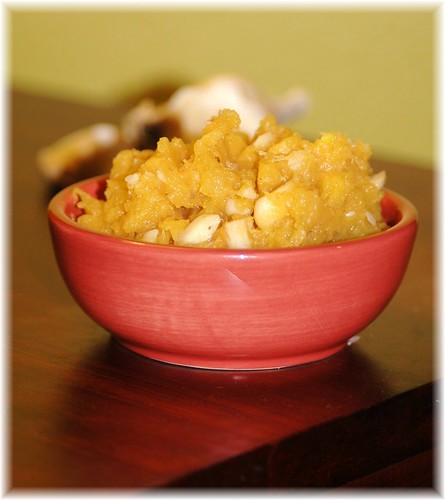 KayKat at 'Cooking from A to Z' presents a 'Squashed acorn squash'. Curious to see what this is about? Check out her post and then you'll be tempted to try and make such a simple and delicious dish.
 Archana at 'Archana's kitchen' keeps the soup trend up with a wonderfully looking 'Spicy Pumpkin Soup'. The cinnamon and cilantro tree adds a beautiful and I'm sure tasty touch to the soup!
 My own entry was a typical Italian 'Risotto alla zucca/Squash risotto', which I prepared with Ambercup and Carnival squash, together with blue cheese to add creaminess and more taste.
 Bee and Jai at 'Jugalbandi' use pumpkin seeds to prepare a wonderful-looking 'Cabbage and Peas Poriyal with Pumpkin Seeds'. Read the entry not only to find out how to make this, but also if you want to laugh :)
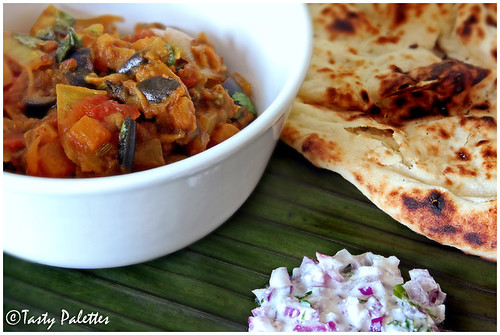 Suganya at 'Tasty Palettes' brings a 'Eggplant And Pumpkin/Butternut Squash Curry' to the squash feast! I love Indian curries, and this is already on my 'to-try' list. :)
 Zlamushka at 'Zlamushka's spicy kitchen' participates with a really interesting 'Squash with sesame seeds' Korean stir-fry, which is part of an amazing looking Korean meal that she put together.. I'd love to try this too!
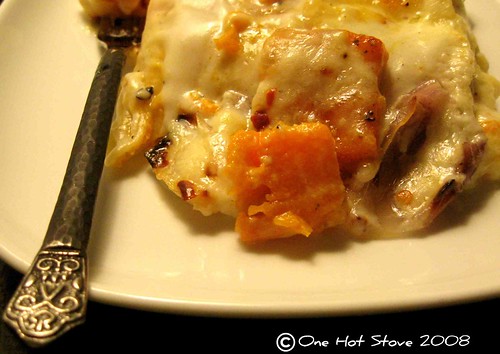 Nupur at 'One hot stove' gives a twist to traditional lasagna by preparing 'Roasted squash-onion lasagna'. I'm sure it tasted as good as it looks - check her post out also if you want to learn about no-boil lasagna sheets!
 Meera at 'Enjoy Indian Food' adds a 'Bhoplyache Bharit - Acorn Squash Dip' to this collection of recipes. Simple, healthy, and great-tasting. What else could one ask for?
 Dhivya at 'Dhivya's cuisine' presents a 'Mixed Squash Curry', which she prepares with Chayote squash. A type of squash that I still haven't tried, and this recipe could be a great occasion to extend my horizons. :)
 Last but not least, dear Meeta at 'What's for lunch, Honey?' treats us with a 'Chickpea Pumpkin Tajine With Coconut Couscous & Coconut Chutney'. A delicious combination of ingredients and spices.
 And.... arrghh... I missed one entry! I'm really sorry, Asha! Asha from 'Aroma!' sent a wonderful combination of 'Thatte(Plate) Idlis with Butternut squash stir-fry and Cilantro chutney'. The three parts of this dish look amazingly good! I've always heard that Idlis were really hard to make, but the way she describes the preparation looks simple! The thought of them combined with butternut squash stir-fry and cilantro chutney just makes me salivate. :)
Thank you so much, everybody, for taking part to the event and creating such a unique and intriguing collection of squash-centered recipes! If you enjoyed reading this roundup, you may want to think about taking part to the next Fresh Produce of the Moth event, which will be centered on... oranges!
Similarly to squashes, oranges nowadays can be found all year round. Still, their peak season is wintertime, and before winter is over I'd really like to dedicate one of our events to this delicious citrus fruit! (this beautiful picture was taken by Wikipedia under Gnu License)
If you'd like to participate, follow these simple rules:
1) Put a post on your blog with a recipe involving oranges. Add a link to this post on my blog and mention that it's an entry for the 'Fresh produce of the month' event. If you like it, feel free to place the logo of the orange-centered event on your post.
2) Send me an email with a link to your post, your blog homepage and your name. My email address is chemcookitATgmailDOTcom. Specify 'Fresh produce of the month' as subject.
3) If you don't have a blog just send me an email with your recipe and if you have a picture of the food you made, that's even better. I will add it to the round-up as well.
The deadline for this event will be March 2nd.
PS - If I don't answer your email or post a comment on your blog entry within three days, please send me another email or post a comment on this blog. Since now I have the comment moderation feature activated, hopefully I shouldn't miss any more entries!!! I'm really sorry if this ever happens again.
| [+/-] |
Death by chocolate contest |
There is a very exciting contest going on, organized by Culinate, and called 'Death by chocolate'. The winner wins a chocolatey trip to Napa Valley for two, to attend the Copia Center’s annual Death by Chocolate Festival, and if no travel money is required, also a dinner for two at the famous 'French Laundry' restaurant. So, how could I not participate? Especially because I have an entry which cannot be beaten:
Cioccolata calda alla Torinese / Hot chocolate Torinese style Dear readers, this is not your common 'hot chocolate'. This is melted heaven. Every time I have a foreign guest in my home town, Torino, I bring them to one of the few real places where they can taste it, and enjoy their expression when they first take a spoonful of it. No one can know what hot chocolate Torinese style is, unless they have tried it. Torino is well-known for chocolate: the famous 'Gianduiotti' come from there..
 (picture taken at 'Baratti e Milano', a very famous cafe in Piazza Castello, one of the most beautiful squares in Torino)
.. and there are many small chocolate factories born there in the XIX century. Hot chocolate is a specialty that every Torinese person drinks on Sundays, during wintertime, in elegant cafes like 'Fiorio'. I thought I would never be able to reproduce this type of hot chocolate at home, but I recently found out how to do so. The trick is to use real dark very good chocolate to begin with. So I started with Venezuelan 80% dark chocolate and broke it into pieces (about 1/4 cup). I then added a small piece of butter (about 1 tbsp), and ~ 2 tbsp heavy cream. I put it on the stove, with very low heat, and added sugar while it was melting (maybe about 1/4 cup total). I also added 1 tbsp Nutella, to give the typical hazelnut flavor that Gianduja Torinese chocolate has. Then, I added enough milk to get the drink of the right consistency: liquid, but very dense (check out how the cream is floating on top, in the first picture I posted). It's probably another 1/4 cup, more or less. The chocolate must be served with sweetened whipped cream on a side. The person drinking it is supposed to add it to the chocolate little by little, enjoying it while it's melting.. a pleasure for the taste buds as well as the eyes!
 So, what do you think: is this entry worth of winning the best chocolate-centered entry for the 'Death by chocolate' contest? If so, please vote for me!!!!! If I win, I promise that if you stop by the Bay area and you voted for me, you'll be treated with a Hot Chocolate Torinese style at Marta's cafe. :)
When you vote, you too automatically enter the draw, and you can also win the same two tickets for the chocolatey tour of Napa Valley. The deadline is February 8th, so.. hurry up!!!
Wednesday, January 30, 2008
| [+/-] |
Frutta e verdura d'inverno |
Meeta at 'What's for lunch, honey' has launched a seasonal event called 'Eat fresh', aimed at getting to know better what's in season in every part of the world. Of course I love this idea! It's in perfect line with the spirit of my own 'Fresh Produce of the Month' event, except for the fact that thanks to Meeta now we'll have a list of produce in season all over the world collected in one place! Congratulations, Meeta, for this great initiative.
So here is my contribution - a snapshot of the fruits and vegetables that I buy more often in Berkeley in this season: There are: squash (turban type), turnips, cabbage, cauliflower, carrots, apples, oranges/mandarins, parsnips, beets (red and golden), potatoes, and peppers (this last is not really in season in my opinion, but in Berkeley you can find almost anything all the time. I buy it when it looks particularly good or it's a special).
I love all winter time produce. And there are so many varieties for each type! Squash comes in so many colors and shapes, as you may have noticed if you've read this blog recently, as well as cabbage, beets and cauliflower... One cannot be bored by them.
| [+/-] |
Pizza alla zucca?!?!? |
I mentioned that for the 'bagna caoda' party I prepared some pizza just in case someone didn't like the bagna caoda. I prepared three types: one was my favorite ricotta and pesto focaccia, another was a traditional grilled eggplant/cheese pizza, and the last one was an experiment (again inspired by the 'San Francisco flavor' cookbook!). I decided to try it as it involves my ingredient of the month - squash. No one would ever make pureed squash pizza or focaccia in Italy (at least not that I'm aware of), but I decided to give it a shot anyway!
Focaccia con zucca / Squash focaccia The recipe in the 'San Francisco cookbook' suggests using delicata or butternut squash for this focaccia. Instead, I used turban squash. I bought it at the Berkeley Bowl intrigued by its beautiful shape and color, and it turned out to be absolutely delicious. I think it's now in the list of my favorite squashes. It tastes a little like pumpkin, and the yield is really high. It smells delicious after baking.
The preparation of this focaccia is quite straightforward: prepare pizza dough (recipe here). When ready, spread on a baking pan, previously greased with olive oil. Bake the squash of your choice, until soft. Scoop the flesh out and puree with a spoon. Add olive oil, salt and oregano (amounts to your taste) and mix. Spread on the pizza dough, and add pieces of cheese on top (suggested by the recipe: cheddar cheese. I used Vermont farmer's cheese). Bake at 400 F for ~10 min, or till the crust starts becoming golden in color. Serve hot.
This squash focaccia turned out quite good - in my opinion not as good as the ricotta and pesto one, but definitely worth trying. I believe homemade pizza or focaccia is one of the best foods for a party: tasty and easy to pick up with your fingers without being too messy. So, I'll send this focaccia recipe as my entry for the 'Game night party' event hosted by Mansi at Fun and Food just for this month! - If you want different pizza/focaccia recipes, look here!
And I hope this recipe also inspires you to send me a contribution to the event I host, the 'Fresh Produce of the Month', centered on squash.. Still a few days open for submissions!
| [+/-] |
Un brunch particolare |
Some time ago I made a really nice brunch for Lucas and myself, using a recipe that I found on my favorite 'San Francisco flavors' cookbook. I never had time to post about it, and this is now the perfect occasion, as it sports the fruit chosen for this month 'A fruit a month' event: papaya! To be really honest, I don't usually like papaya too much. This is strange, because I like almost anything. Papaya has a strange aftertaste that somewhat bothers me, when I eat it raw: after the sweet feeling, there is something that remains in my mouth and reminds me of fermentation and, somehow, cheese. I know it's just a weird idea that I have, but I cannot it too much of it raw. But, in this particular dish I'm showing, I really liked it. Maybe because the person who thought about it somehow read my mind and decided to accentuate this 'aftertaste' by just combining it with.. brie! So, here I present to you...
Quesadilla con brie e papaya / Papaya and brie quesadilla (Recipe adapted from 'San Francisco flavors' - originally, the quesadillas are baked, and more fats are used).
Prepare the filling by mixing one papaya, peeled and diced, one onion, thinly sliced, the juice of two limes, 1 jalapeno chilli, minced, and 1/2 bunch cilantro. Melt 1 tbsp butter in a separate bowl. Lightly butter (with a separate piece of butter) an anti-sticking pan, and place it on the stove on moderate heat. Place a large tortilla on it, and add some of the papaya mix on half of it. Add a few pieces of brie (you choose how much). Close the other half on top, and brush with some of the melted butter. After ~5 min, flip the quesadilla paying attention not to pour the filling everywhere in the pan. Brush more butter on top of the quesadilla, and cook for a few more minutes, till the brie is melted. Repeat till all the filling is finished. I used only half of it, it was enough for a brunch for two. The quesadillas should be eaten hot.. They can also be used as appetizers, if you cut them in wedges before serving. I made them a few times, as they are really quick to prepare and delicious, and unusual too!
Tuesday, January 29, 2008
| [+/-] |
Minestrina!!!!! |
There are two events on the food-blog-sphere dedicated to some sort of comfort food these days: one is the 'Monthly Mingle', hosted by Meeta at 'What's for lunch, honey', themed in fact simply 'Comfort foods'; the other is the 'Click' event started by the Jugalbandi band, themed 'Liquid comfort'.
My decision is to present the food that has been the comfort food during all my youth, and still is. As it happens to be liquid, it goes greatly for both events. The thing is: it's really nothing fancy at all! But then again, otherwise it wouldn't be a true comfort food.. It's actually the fear of every Italian child, because it doesn't contain anything really super tasty, or sweet, or child appealing. But in my family, it has always been regarded as something really nice and comforting to have, and it reminds me of my mom and my grandma, who'd prepare it for all of us, especially when one was sick. I'm speaking of 'Minestrina' (lit. small minestra, which is kind of like a soup)! It's nothing but a very simple broth, with some small type of pasta in, and some olive oil and parmigiano cheese grated on top, if one needed to add some more nutrients to feel even better. It's been really hard to try to get a flattering picture of this really simple subject. This is the best I could come up with, and I'm going to present it to 'Click' in any case, although I realize it doesn't really compare to the other entries. :)
Minestrina To make minestrina, you just need to have some vegetable broth (prepared with boiled onions and carrots and celeries, or simply with a vegetable bouillon), and boil some small pasta in it. The ratio of pasta to broth is all depending on your taste. I'm more for liquidy minestrina, but my dad likes more pasta, for example. Here you see stelline (little stars). Before serving, add some olive oil and parmigiano if you feel like. It needs to be eaten hot, and it will make you feel warmed up and comforted and loved!
It goes right to Meeta and Bee and Jai for their 'Monthly Mingle' and 'Click' events, respectively!
Sunday, January 27, 2008
| [+/-] |
Bagna caoda |
When Sunita launched garlic as her 'Think Spice' theme, I felt immediately excited and involved: garlic is definitely the Italian spice, the only one that we really use a lot (together with a few other ones). So, for once, I felt perfectly at ease with a spice theme! But then I started wondering: garlic is so widespread in Italian cuisine, which dish doesn't contain it? There are some dishes that definitely would not exist without garlic, which everybody knows and loves: pesto, tomato sauce (here called 'marinara'), bruschetta. But for this event, I wanted to present something that was an 'ode' to garlic, and if possible, not too well known outside Italy. That's how I thought about 'bagna caoda'. Literally, the name of this dish means 'hot bath': and it is, in fact, a hot, extremely garlicky bath, for vegetables! It's a dish traditional from Piemonte, my region, and it's eaten in winter time. So, what could be more perfect for the 'Think Spice' event? I prepared it yesterday, and we threw a large party in its honor. It was a lot of fun! And to my surprise, everybody loved bagna caoda: I had prepared some back-up pizzas, just in case, but they didn't seem to be necessary..
So here is the recipe for bagna caoda. As you will see, it requires a huge amount of garlic and olive oil, and anchovies. I prepared also a vegetarian version, without anchovies, with chili peppers instead, which was also quite good, and appreciated by vegetarians and people who didn't like anchovies. The whole bagna caoda experience involves a few particular vegetables to dip in, together with some more common ones. Luckily enough, Berkeley Bowl provided also the 'particular' ones!
Bagna caoda
Ingredients for about 15 people, or a few cans:
8 heads of garlic (not cloves, heads!!)
1 lb anchovies under salt (I found them imported from Italy, in a huge 1 kg can, again at the Berkeley Bowl - they should be whole, preserved only under salt and nothing else)
~3/4 liter olive oil
Vegetables: potatoes, onions, peppers, celery, beets, fennels, Jerusalem artichokes, cardoons, cabbage, turnips are traditional. We also added mushrooms, parsnips, carrots, zucchini, celery roots, broccoli, brocco-flowers.
To make the sauce, peel all the garlic, and cut it into thin slices. Clean the anchovies by removing the central bone and interior parts, and then wash them from the salt. Put all the garlic pieces and anchovies in a pot, and cover with oil. You should use about 3/4 liter. Cook on very low heat for about two hours, until the garlic is very soft, and then squish all the pieces with a spoon, till a sort of olive oil/garlic/anchovie paste is obtained. You should add a generous piece of butter to this sauce before serving it, but I forgot to do it, and I must say, it was delicious also in my 'healthier' version.
For the vegetarian version, cut the garlic into slices, and cover with oil and cook in a similar way. Add pieces of chili peppers and salt to taste while cooking. The problem of this version is that the garlic tends to clump separately from the oil (apparently the anchovies have also a 'surfactant'-like function...). It's good in any case. If you want, you can add some cream (the famous 'panna da cucina' which I already mentioned in this post), to help the formation of a paste. This will make it a little less traditional, but the most 'modern' versions of bagna caoda add this cream in any case, to smooth the taste of the garlic.
In the meanwhile, prepare the vegetables: bake the potatoes, onions, beets, turnips, parsnips and peppers. Slice all the vegetables that need to be (the baked ones and the raw ones), or simply cut into 'handy' pieces the veggies such as carrots or celery or cardoons. The goal is to have pieces that one can dip in the sauce and eat conveniently.
The best way to serve bagna caoda is having it on the table on top of the traditional burners, such as those used for fondue, with a candle in it: the bagna needs to remain caoda (=calda, i.e. hot, in Piemontese dialect), while you eat it. Our arrangement was a little less elegant, but still worked..: The bagna caoda was set on an oven rack, with a candle below it.. :)
At this point, you're set: start dipping the veggies in the sauce, and eat them! The most fun part is to try the taste of the sauce with all the different vegetables. Here is only a small portion of the vegetables we had: Everybody brought some veggies, according to what I suggested, and we ended up with a real feast for the eyes and the stomach. I baked also some bread, which is also delicious to dip in the sauce, of course.
I'm sure someone is curious about those weird vegetables that I named above. So here they are:
Jerusalem Artichokes These are apparently also known as 'sunchokes' in English. Their Italian/Piemontese name is 'tobinambur', 'topinabo', and variations on this theme. They look like potatoes, but they are much crispier. You can eat them raw, baked, or in casseroles. We baked them for the bagna caoda, and they acquire a very delicate and nutty taste, this way.
Cardoons (picture from 'The seasonal chef', as I forgot to take mine).
These are called 'cardi' in Italy, and there is actually a special variety that one should use for bagna caoda, called 'cardo gobbo', which is 'hunchback' (='gobbo') compared to the straight one that you see in this picture. It's a really strange vegetable. Bitter and tough, better to eat it raw to avoid the bitterness become intolerable. Forget about eating the leaves, too, they are super bitter. In any case, they go nicely with the strong contrasting taste of bagna caoda.
Well, so here is my (late) entry to Sunita's event, and I hope everybody enjoyed reading about this traditional dish from the 'cuisine for the poor' of Piemonte! Check the roundup here!
Monday, January 21, 2008
| [+/-] |
Curry vegetariano multietnico |
My first experiments of Indian cooking inspired me while I was cooking something simpler (and with no spices involved). I didn't really take the recipe from a specific cookbook, but definitely the making of this dish was related to what I read in Indian recipes from blogs such as Jugalbandi and One hot stove. So here is what I prepared: it's a vegetarian curry, with ingredients coming from cuisines from all over the world: Poblano peppers from Mexico, coconut and peanuts from India and Thailand, parseley from Italy, bok choi and tofu from China. The result was really good, and something very different from what I usually cook.
Curry vegetariano multietnico / Multi-ethnic vegetarian curry
To prepare it, dice 1/2 lb of tofu and sautee it in 1 tbsp olive oil, till brownish. Add 2 leeks, finely cut, and sautee together. Then add also 4 poblano peppers cut into pieces and keep cooking. In the meanwhile, blend together 1/2 cup raw peanuts and 1/4 cup dried grated coconut, and a small bunch of parseley leaves. Add 1/4 cup garbanzo bean flour, 1/4 cup heavy cream and 1 cup milk. Roughly cut leaves of 4 bunches of bok choi and add to the pan with the veggies and tofu. Add salt and pepper to taste. Saute for 5 min and add the blended paste. Add enough water to make a curry-like consistency and simmer for a few more minutes. Serve with basmati rice.
I loved the combination of the spiciness from the Poblano and the 'rough' taste of the bok choi, with the sweetness from coconut and the creaminess from milk. I'd like to submit this dish to the 'Weekend Cookbook Challenge', which is themed 'Veggin Out', but I'm one day late, so I'm not sure if this will be accepted or not.. we'll see. :)
Saturday, January 19, 2008
| [+/-] |
Una serata a teatro |
For our anniversary, Lucas and I decided to do something a little different, and we went to see a theater play! We both love theater, and we would like to try and go more often, so this was a good beginning. We went to see 'Barefoot in the park', played by the Actors Ensemble of Berkeley, at the 'Live Oak Theater'.  It's a delightful comedy written by Neil Simon about a newly wed couple and their first struggles due to different expectations and characters, with a happy ending. The comedy is full of really funny jokes, and the actors are very good! The whole audience was laughing a lot. If someone who reads this lives in Berkely, I'd strongly recommend going to see the show! It's a community-based theater, very inexpensive ($12!!), small and friendly.. these actors have a very interesting program for this season, and we're thinking of trying to go to a few more of their shows.
| [+/-] |
Esperimenti di cucina Indiana! |
The new year has come, and one of my resolutions was to try and finally learn how to cook Indian dishes! I love Indian cuisine, and I still didn't dive into trying it because I've always been scared by all the spices that are necessary. I love spices, too, but I don't usually keep them at home, and the most exotic one I have is turmeric.. But in the past year, I got to know so many great Indian food bloggers, so I decided I could just start trying to repeat some of the simpler recipes they show, and little by little, I would get a hand of cooking with spices! In this post, I'll summarize my first two attempts. Both of them are dal-centered: I prepared Sambar and Pumpkin Amti. The two dishes are typical of different parts of India, and it was really nice to taste them both.
Ulli (shallot) Sambar This was my very first Indian cooking attempt! I used Jai and Bee's recipe, which you can find here, so I won't rewrite it. At the time, I still hadn't visited a true Indian store, and so I didn't have all the spices requested. I know I missed very important ingredients such as tamarind, and I used spicy serrano chillies instead of red and green Indian chillies, and I had no curry leaves. In fact, when I told my friend Vardha that I made Sambar without the Indian chillies, he told me I didn't really make Sambar.. but to be honest, the result was (at least to mine and Lucas's taste) absolutely amazing. I was so excited! I actually made something that tasted really good and at least resembled closely enough an Indian dish! This opened the doors of a big adventure.
The next day I asked a few Indian friends where they buy their spices. Berkeley Bowl is great for most things, but definitely not for spices. I went to 'Milan International', and I was fascinated and lost between the hundreds of boxes of loose and packaged spices. I bought as many as I could remember the names of, and came back home happy. I also bought a traditional spice box! So for my second attempt, I was ready and had almost all the ingredients!
Pumpkin Amti This is a Maharashtrian dish, and I found the recipe on Nupur's blog, One hot stove - link for the recipe is here. I liked this dish also because it allowed me to experiment one more type of squash - I used 'delicata squash' for it, which has a really good taste. The taste of this dish was very rich - as Nupur says, there are so many flavors that mingle in it! We enjoyed it a lot, and I felt a little more comfortable while making it, and I was faster than when I made Sambar. If I must make a comparison, though, I think I enjoyed the taste of Sambar better. But the use of coconut and peanuts in the Pumpkin Amti was really inspiring, as you may see in a future post.
After these first attempts, I can give a few comments about the experience of Indian cooking. It's exciting, and I feel a little bit like a wizard. It's more complex than Italian cooking, as many things need to be cooked separated, and it's also somewhat more dangerous.. I was really coughing a lot while cooking the hot peppers on the stove :) Also, while I'm perfectly confident about not having a recipe when I cook an Italian (or European, or American) dish, I noticed that I really need precise doses to cook Indian food, for now.. but this will hopefully improve with practice! Thanks Nupur, Jai and Bee for the recipes, I'm looking forward to a year of new adventures in the kitchen..
| [+/-] |
Risotto con zucca |
A few days ago I prepared a delicious squash risotto, which I'm going to present for my blog-event, 'Fresh Produce of the Month', which this month is dedicated to Squash. You still have a few more days, so please send in some delicious entries!The risotto I'm going to present is typically Italian, although we would use pumpkin instead of squash. In Italy there aren't as many types of squash as there are in the US, strangely enough, so right now I'm really enjoying trying out all the different varieties, and deciding which ones I like the best. For this risotto, I used two squashes, Ambercup and Carnival. You can see them here, after I baked them. I tasted a bit of pulp before using them for the risotto, and I found that the Carnival had a delicious sweet and full taste, whereas the Ambercup was much more blend, and I used it mostly in order to give some creaminess to the sauce. If you want to have a few more information on the various types of squash that can be found in the US, look here.
Risotto alla zucca / Squash risotto To make it, first of all bake the squash, remove the skins and cut the pulp in cubes. As you can see, I had a really big squash and a smaller one. You'll need quite a lot, if you follow the rest of the doses, and you'll end up having rice for ~10 people. Then, finely cut one big onion and sautee it on medium heat in 2 tbsp olive oil, until gold. Add 3 cups of arborio rice, and stir for a few minutes, so the rice is coated in oil. Add the squash pieces, salt (~1.5 tbsp), and cover with enough water so that you have at least half an inch of water that covers the mixture of rice and squash. This should be about 5-6 cups of water. Cover with a lid and bring to boil. Once it boils, decrease the heat, and simmer for ~15 min. Add 1/2 cup of cheese of your choice (I used blue cheese for a stronger taste, but cheddar would also work well), stir so that the cheese can melt, and cover the lid. Simmer for another 5 min, making sure that there is enough water. Adjust salt. The rice should be cooked and still firm but definitely not al dente. If it's too hard, add some HOT water and simmer for a few more minutes. Turn off the heat and let the risotto rest for about 5 minutes. This will make the rice soft and of the right consistency. Serve with some parseley, Parmesan cheese and black pepper to taste.
Subscribe to:
Posts (Atom)