Dissatisfied with my dashi, I journeyed to Izumo.
OK, that's not entirely true, but I like the sound of it. And it's not entirely false either. Once I had felt I had gotten the knack of making dashi, as detailed in Quest for Katsuobushi, I tested my new skill on Marta's friend Keisuke and his family. The soup I made was just as described before: dashi made from kombu and katsuobushi, salted to taste, with small chunks of soft tofu and thin slivers of Japanese green onion. Keisuke said the broth was nice, but then ever so politely wondered why there wasn't any miso in it, or rice alongside.
These were good questions, but it wasn't that I hadn't thought of these things. Katsuobushi, according to the food scientists, has one of the most complex flavor spectra of any food. Wouldn't it be a shame to mask its depth of flavor with miso, itself no slouch in the complexity department? And rice. I don't have any problem with rice. It's good when made well, but why not focus on less humble foods when you're aiming to impress?
Why not? Because "dashi is deep". It's not simply about its large number of different flavor molecules, its "lactic acic and amino acids, peptides, and nucleotides, . . . , pungent phenolic compunds, . . ., nitrogen- and sulfer-containing carbon rings, . . ., flowery, fruity, green notes" [McGee again]. It's about much more than this, as I was to learn.
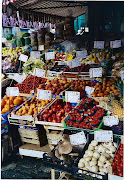
Let me begin by saying that katsuobushi is not quite as hard to find in Japan as I had thought, even though Keisuke had told me that I was the first person he'd ever seen holding it. Indeed we saw katsuobushi our very first day, simply because we happened to visit Tokyo's Tsukiji, the biggest fish market in the world:
Surprisingly, whole katsuobushi was more expensive by weight than flaked. We conjecture that's because the flakes are made from more unattractive specimens. Sometime later, I turned on the TV to see a cooking show wherein they stewed 5mm (!) slices of katsuobushi until soft, then cooked them with bitter melon. Toward the end of our trip, we saw katsuobushi again in Kyoto's Nishiki gourmet shopping district.
My first katsuobushi, however, had come from Izumo, and Izumo seemed to be a good starting point for an eastward bike trip from rural to urban Japan. No doubt e-dashi's Hiromi and Haruo, living in Japan's least populous Shimane prefecture, were doubtful that we'd follow through when we said, "Hey, we'll be in Japan. Maybe we'll drop by." But then, we had surprised them already: We learned that ours was the first order, in their 10 years on the web, from gaijin.
Given our novelty, maybe we shouldn't have been entirely surprised that we were greeted by more than a simple hello. But then I don't think there was any reason to expect the ensuing full-court press of hospitality. Marta has already described part of it. Here is the rest:
After visiting Izumo taisha, we were brought to e-dashi's store, which is built into the front of a 100-year-old house. The inside is a study in restraint. Unlike in America's overflowing aisles, the stock is arranged to fit the room, like museum exhibits. There was everything needed to make good dashi: katsuobushi, of course, but also (giant--see below) kombu, mushrooms, small dried fish, and---here I finally see one---a katsuobushi dezuriki, the plane traditionally used to make the flakes. I was interested, of course. First, though, lunch to a very good tempuraya. Before we leave, Hiromi places two pieces of kombu to cold-steep in a pan of water.
When we return, I learn about the dezuriki. Like other Japanese planes, it consists of a block of oak with a slot cut into it, just large enough so that the iron can be wedged in. The block then fits into the drawered box that catches the flakes.
The iron is made of two layers of metal, one soft and one hard. The soft layer gives support to the harder cutting edge, and makes it easier to remove metal when sharpening. This is important because the cutting steel in Japanese tools is considerably harder than in western cutlery. The iron is set into the oak at a rather shallow angle---10 degrees less, I'd say, than the Sheffield plane I used before. The smaller angle means that each shaving bends less as it's removed. In woodworking, we don't care at all about the shavings; only what's left counts. Here they're important, aesthetically at least. If shavings bent as they are removed, they will become opaque and rough. Perhaps the soup doesn't care, but if you want the flakes to look pretty dancing, better they be shiny.
Here Haruo shows me how to use the plane, which he had restored himself:
Here Haruo demonstrates. He was much more fluid than I.
Here one must be careful not to make finger shavings also---the blade is razor sharp, or sharper ("Razor sharp isn't sharp!" once insisted a guy at Japanwoodworker).
Haruo also shows us an intermediate stage of katsuobushi. This piece has picked up a layer of char from weeks of exposure to smoke. This char will have to be removed before the piece is inoculated with mold.
We are now ready for the dashi lesson. Heat the water. As soon as bubbles start to appear, remove the kombu. Heat the water to boiling, and add the flaked katsuobushi, 5 to 7 grams per cup of water.
Remove from heat and let steep until the flakes sink to the bottom. Strain.
What I didn't do before: Add equal parts red and white miso.
An aside about miso: Miso is a fermented mixture of soybean and rice. White miso has about 4 parts rice to 1 part soybean, and ferments for a month or so. Red has soy-to-rice ratio anywhere from 1 to infinity. It ferments much longer, for six months or so. Miso is much like cheese, in that it is cultured many ways. Earlier, Yokohama's Hideo and Yoko had us try red miso from Nagoya, which was much earthier than others.
To add miso to dashi, one typically emulsifies it inside a spoon with some of the dashi. Traditionally there was a special spoon just for this purpose, but any will do.
Now reheat the dashi to just below boiling, and add whatever else you have planned. Here, Hiromi is using a type of tofu.
The finished soup:
This soup was, not surprisingly, very good. However, the miso was masking some of the smokiness of the katsuobushi and the sea smell of the kombu. How was I to accept that the the most hard-to-find and complex ingredients were playing the supporting role in this soup?
This wasn't to be our last taste of dashi in Izumo. When Hiromi prepared for sushi handrolls for dinner, she cooked the rice in dashi. Again, very good, but a supporting role for the katsuobushi.
The attentive and faithful reader of this blog may have noticed a resemblance between the dezuriki above and the one shown earlier alongside miso soup and dashi rice in Quest for Katsuobushi: Intermezzo Anacronistico. Before we left the house that night, Hiromi asked two questions from a printout. First, "Are used goods okay?" Sure, everything I own is used. Second, "Would you like to have the dezuriki?"
Flash forward to last August. The dezuriki had arrived by mail from Izumo, and I was trying put together a set of return gifts that would suitably express how much I appreciated their profound generosity. We had tried to teach Hiromi and Haruo's sons a bit of English while waiting for dinner, and they had said they liked the manga Dragonball Z, so I went to a Berkeley comic store to look for the English version. On one shelf, there was a tag from the employees recommending a manga called Oishinbo, about a group of foodies traveling Japan assembling the "ultimate menu". This popular manga had had a long run starting in the 80s. The English translation was a compilation, "A la Carte", of episodes arranged into a "full-course manga meal". First course: "The Secret of Dashi." Well well.
In this episode, our hero Shiro rescues the stand-in chefs at a Tokyo keiseki restaurant, who are struggling to make a dashi that will be accepted by Shiro's demanding father, who happens to be in a different room in the same place. Shiro's dashi procedure is roughly the same as Hiromi's, with some differences: Instead of letting the kombu soak, Shiro first gently rinses it under the tap water, then slides it through the hot water in the pan in just one pass. (The footnotes call this technique "hikidashi kombu"--to draw forth the kombu.) Shiro seems to reduce the steeping time for the katsuobushi flakes as well: He claims that boiling would draw out the fish flavor, and one wouldn't want this fish flavor to compete with that of the fish served in the soup. The manga is describing just what we had in Kyoto.
The characters say the dashi is very subtle, but with a fine flavor. That is, even when there is no miso, the dashi must still be in the background. When the intensity of the mixins goes down, so must the dashi.
I asked Hiromi about this by email. "The professional uses dashi properly by the dish. Dashi is deep, and interesting," she wrote.
In summary, there is no one way to make dashi, but whatever you do, dashi can only be the soup base, it seems.
To understand why dashi must be the background, I had been thinking about the history of katsuobushi. Like preserved foods the world over, it was developed in a time before refrigeration. Living off the sea, the early Japanese had a mixed blessing. The waters, when generous, supplied a wondrous variety of fish. But when the seas were rough, the schools of fish had moved on, and the supply drew short, what was left quickly spoiled in the heat. Rice supplied neither a complete set of proteins nor flavor that could be enjoyed indefinitely. So, I figured, the Japanese learned to turn fish to wood, so that it could enhance the flavor of rice in times of scarcity. To bring these flavors to the forefront would be prodigal: they are there only to help us enjoy what we have, to help us through the tough times.
But I figured wrong! Other sources tell me that rice was just as unavailable to the early, poor Japanese as fish, perhaps more so. The least expensive grain was instead wheat. That, I guess, moves miso up in prestige. Does that explain everything, then? Miso and katsubushi are coequal partners? "Dissatisfied with my miso, I journeyed to Nagoya . . . " I like the sound of that.
Wednesday, November 18, 2009
Quest for Katsuobushi, II: "Dashi is Deep"
Posted by
Matt
at
11:19 PM
5
comments
Labels: dashi
Sunday, October 25, 2009
Ultimo post sul Giappone—dal Canada!
Hi everyone! You thought I was lost forever? No. However, I am thinking I should change the title of this blog. I'm not in the US anymore! I moved to Canada about a month ago with Matt.
I have now a job in Montreal. After a lot of struggle and indecision, I opted for this job over a few other offers I had, and here we are! I actually really love this new job and I'm immensely happy Matt was able to join me. So, so far so good. But, winter time has not arrived yet. We are still enjoying the last beautiful Fall days and I do want to take some pictures before it's too late and all the colorful leaves are gone.
However, before I tell you about our new life, the cross-country move, and my summer trip to Italy after Japan, I want to write the last post about Japan, which will tell you about our last day and a half in Japan, discuss Japanese home food and a summary about what we've learned about biking in Japan.
So, let's get started.
The morning before we left Kyoto, we biked through the temple area. We managed to see one of the biggest Shinto shrines:.. And did a quick run through the Philosopher's walk, where all the most beautiful temples are. We saw some of them from outside, but unfortunately didn't have time to go inside. However, we met a really nice old guy, who kept trying to show us something in the small canals that border the walk. It took us a while to figure out what he wanted us to see: little frogs! We met him again later, showing the frogs to a kid.
This is actually the last picture we took in Japan, showing a little sign of friendliness between cultures and generations.
In a hurry, we biked back to Kyoto station, bagged up the bikes, and got onto the Shinkansen. We thought that would have been our last time with the bikes, as Matt found two buyers on the (English) craigslist who were willing to buy them from us at our arrival in Tokyo. However, one of the buyers flaked out, and we were left with Matt's bike. Luckily we found a hotel with internet, and emailed one of the previously interested, who agreed to take the bike.
We managed to enjoy at least some of our last day in Tokyo. We took a walk downtown, and saw a South Indian restaurant that attracted us. Without even realizing it, we were missing spicy food! This Japanese Indian restaurant turned out to be fantastic. We had some amazing idlis made with semolina flour and raisin, and one of the best lamb curries we ever tasted. Again, Japan food really never disappoints, whatever cuisine one wants to try. (Though in this case there were at least Indians in the kitchen.)
Our last evening in Tokyo was quite nice too. We found a little park in the heart of downtown, and sat on a bench there for a while. We were surrounded by trees and a little further, tall skyscrapers. In the middle of Tokyo, it was quiet.
The day after, we sold the last bike about half an hour before we left for the airport. Thanks, craigslist! The flight back went smoothly, and in less than 10 hours we were back to California.
-- -- -- -- -- -- -- -
Japanese home food
-- -- -- -- -- -- -- -
As you know, we got to know many really nice Japanese families, either through the Japan Cycling website, or thanks to Matt's interest in katsuobushi. All the people we met showed us what Japanese hospitality is—not only did they share their house with us, but they made us feel part of their family. They showed us around, helped us find bikes, brought us to restaurants, chatted with us, introduced us to their friends, even played videogames with us and their children . . . and of course, prepared food for and with us.
Our first night in Japan (my birthday), we were hosted at Yukiko and Carlos'. I was so impressed that Yukiko had organized a cooking lesson for me! Every month she and a friend were taught one meal, and she planned it this month to coincide with our stay.
So here we are, four women preparing food.The first dish was cold oden, with chicken meatballs, seaweed, tomatoes, wax gourd, konnyaku, and quail eggs. I was in charge of the meatballs.
Here the chef cools down the carefully arranged soup in ice water.
And the final result:
We mentioned konnyaku already in this post. This soup was deliciously refreshing—but we were told that it can be made warm, too, for wintertime.
The second dish we made was a stir-fry with pork, pumpkin, and green and red peppers.
And finally, there were two amazingly good side dishes:
Rice with shiso and ume, and dashi with myoga. The shiso-ume rice has since then become one of our treats. We made it many times in Berkeley (after buying a shiso plant), and we were very sad we hadn't seen any shiso here in Montreal. However, happy times will be back, as we just found both shiso and ume yesterday. :)
The myoga dashi was oishi too. This was our first time seeing a Japanese person making dashi, so we discovered here the technique of dissolving the two miso pastes (red and white) in a spoon with some broth before putting them in the soup. But as you already know, we would have learned a lot more about how to make miso soup in a few more days. Matt will post about our dashi lesson soon.
This joyful meal including an unexpected Japanese cooking lesson was a perfect birthday gift for me.
The second night at Yukiko's, we made some Italian food in exchange. We made some tomato-shrimp spaghetti, and a pumpkin-sausage rice, which were very much appreciated. Matt prepared also his really good fried sweet potato and salami appetizer (I will describe it in another post). However, we realized that the salami we were able to find was not as acidic and flavorful as the one we used to get in Berkeley. Good salami and chocolate are some of the few things that we couldn't find in Japan.
This meal was served with a good Italian wine that was brought by neighbor Pierre. We were joined by Yukiko's husband Carlos, and Masa, another friend from the Tokyo Great City Tour, who had been with us in the morning. If you check out the 'about us' section of their website, you can find pictures and some details about Yukiko, Carlos, and Masa.
On the third night, we were hosted by Yoko and Hideo at Yokohama. After bringing us around all afternoon to find our bikes, Yoko prepared dinner for us too!
She explained that the day after was going to be 'eel day' in Japan. This is apparently an excuse to allow people to eat a eel in summer time, which is normally to be avoided, as eel is very fatty and caloric, better suited to sustain people in wintertime. But the Japanese love eel, so this is a welcome occasion. She prepared 'three way eel', which is broiled eel eaten either with plain rice, or with rice and some toppings such as green onions and ume, or eel with these toppings and dashi.The most complete 'third way' was our favorite:
The eel was served together with a special dashi with clams:
This dashi was made with miso paste from Nagoya which is particularly dark and flavorful.
My contribution to the meal was peperoni con bagna cauda.I thought this would have been a novelty for Yoko and Hideo, but I was totally wrong! Not only did they know the dish, they even knew the Piemontese name for the the garlicky sauce, and they prepared it for themselves many times!
The day after, Yoko prepared a typical Japanese breakfast for us:
The central dish is a baked fish (we had this and some salmon), and it is surrounded by steamed rice, mountain potatoes with ume and sesame seeds, natto and a miso soup with sprouts. This is a traditional breakfast, but we were told that most people nowadays simply eat a bread and drink coffee.
If you are curious, mountain potatoes are a slimy type of yam, often eaten grated on top of soba noodles. Matt had them in this version when we ate our second dinner with Iwao. Natto are fermented soy beans, to be eaten with rice, which can be found also in Japanese restaurants in the US (not sure about Canada yet). They are also slimy and they have a strong, acquired taste that not even all Japanese like, so our hosts were quite surprised that we liked them.
This was a delicious and healthy way to start our day. Yoko prepared also some ume onigiri and gave us some sweet bread that sustained us during our trip to Izumo.
In Izumo, as you know, we met our friends Hiromi and Haruo, the owners of the e-dashi store that Matt ordered katsuobushi from.
We started our day in Izumo having breakfast with them. They brought us at a nice, French-Japanese breakfast place, where we had one of the best French toasts ever: light and fluffy, and not overly sweet or cinnamony!As we would have found out later, Japanese are great chefs no matter what style of food they are making. Their really good results are the outcome of a deep study of the cuisine they are reproducing, and their additions are often quite nice, such as this green side salad and the piece of watermelon.
After the visit to the Izumo Taisha and to their store, Hiromi and Haruo brought us for lunch at a Tempura-Ya owned by a friend of theirs. We asked them to order for us, and we had a delicious shrimp and a vegetable tempura. Here they are at the restaurant, before the tempura was served.The climax of the day was the dashi lesson that we received in the afternoon.
We were to leave after that, but a really strong rain convinced to stay. And what a gift that rain was! We would have missed a third delicious home-made dinner, and an unforgettable evening.
For dinner, Hiromi and Haruo wanted us to try two foods we hadn't had yet: okonomiyaki and hand-rolled sushi.
Haruo cooked a traditional okonomiyaki for us, with cabbage and pork.While Haruo was making okonomiyaki, we were helping the kids practice some English—which started working when Matt discovered some common vocabulary in American basketball. I'm happy at least he knew something about it. Then the younger child brought out an electronic device to show us, some combination of camera and portable computer. He showed how to distort the video of his dad cooking and, later, his face.
Between this and their microwaves (select any temperature!), we saw in Japan tomorrow's technology today.
Back to the food, the okonomiyaki looked and were good.We described okonomiyaki in another post, when we tried one in its home city of Osaka.
Hand-rolled sushi is a convenient way to have sushi at home. A dish containing all the fillings brought to the table:Here we have a tuna salad, surrounded by tamago (Japanese rolled sweet omelette), yellowtail, salmon, cucumber, shrimp and shiso. There was another dish with eel, a big bowl of rice (cooked in dashi), and a plate with crispy seaweed. Everybody picks a piece of seaweed, spreads a thin layer of rice on it, and adds the desired toppings. I learned a lot looking at the children, real experts. Tuna salad and shiso went nicely together, as well as cucumber and salmon, for example. We really enjoyed both the okonomiyaki and the sushi. The warm and cheerful company made us feel at home.
Afer dinner, we were brought upstairs, in the large tatami room of their hundred-year-old house.One thinks of these rooms as a static setting for Zen-like serenity, but of course, when real people live there, they do real people things. In this case, playing video games. We sat down on the tatamis and proceeded to play Wii Mario Cart against players from other countries. Matt shamed Japan with his poor showing, but then the kids took over, and executed a thrilling come-from-behind victory.
And here is a group portrait.
So this was our last experience of home-made food. We do hope we can go back to Japan and visit some of these people again, and some of the families we missed.
-- -- -- -- -- -- -
Meeting Japanese people and sharing a bit of their lives was probably the best experience we had in Japan. What else did we learn from this trip, and what would we repeat or avoid if we went for another bike tour of this beautiful country? Here is a short list of our dos and don'ts.
-- -- -- -- -- -- -
Yes!
Pack light. We made quite a few people jealous at the airport, when they saw us with just two small backpacks and couldn't believe we had been there for so long. Pack just a couple of T-shirts, possibly made of some quick drying material, few socks and underwears, a sweater. We brought biking shoes but ended up using them rarely.
Bring a Japanese-English dictionary. This was extremely useful. We had also a phrasebook that turned out to be less useful, especially after we lost it.
Try to learn some Japanese before going. We knew very few sentences, some of them completely useless. Pimsleur's dialogue patterns—such as "You speak very good Japanese!", followed by the modest "Thanks, but I'm not skilled yet"—did not happen as advertised. However, what little we did learn gave us some ear for the language, which was probably better than nothing. We promise to learn more before going back.
Go to smaller cities in areas such as Western Japan if you want to learn some Japanese. In Tokyo, Osaka and Kyoto, most people will know some English.
Go to tourist offices to find inexpensive accomodations. These are usually located close to train stations, and you will most likely find somebody who speaks some English or at least has a computer that you can use google translate with. They will ask you for how much you want to spend, and whatever you say will most likely be precisely what they'll find.
Buy the cheap plastic bags at a hardware store to carry your bike on the trains. They are easier to use than the expensive sturdier bags you can buy at specialized sport stores, and about 10 times cheaper. You probably don't need to keep the bag after the trip, so the cheap ones (~$3) are perfectly fine. You can see here that we fell into the trap of buying one expensive bag, but ended up preferring the cheaper one—the bike was a lot easier to pack into that.
Organize so that you can be hosted by some Japanese families, or at least meet with some locals.
Be open to what happens. A biking trip cannot be planned in detail, especially in an unknown country. So, be prepared to be ok if you have to spend more time than intended somewhere, or stop earlier than you thought if it rains or the distance turns out to be longer than you predicted.
Talk to people. No matter how little Japanese you know and English they know, you will always be able to strike up some interesting form of communication. These encounters will remain in your memory better than many temples.
No!
Don't try to buy or sell used bikes in Japan. It really doesn't work very well. That's what we did, but we ended up using up a lot of precious time. Japanese really don't have a second hand market (this is an interesting cultural phenomenon by itself), so there's no active equivalent of craigslist, and the resale value of anything you buy in a store, used or not, will be about half of what you spent on it. Thanks to Yoko, we found a store in Yokohama that sold us the used bikes you saw here, for ~$300 each. But we lost about a day and a half doing this, and then we spent many more hours trying to sell them, as explained earlier. The whole process was very stressful and not to be recommended. Probably best to bring your own bike, and suck up the expense for the delivery. That's what we'll do next time, or, now that we know some people, we may try to see if we can arrange some ad-hoc renting for the time we're there. This time, we couldn't find a place that would rent bikes for a week or so.
Don't go to Japan during the rainy season. We were told that the rainy season would be over on July 15th, which was only partially true. In western Japan, it stops later. It's not as predictable as they would have you believe ("Rainy season will stop next Tuesday!"). However, probably better to go towards the end of the rainy season rather than in full summertime, when the heat would be unbearable.
Don't exchange food with your chopsticks. This gesture is used only during funerals, when the bones are passed from one person to the other using chopsticks. The same ceremony is not appropriate for noodles, no matter how undercooked.
Posted by
chemcookit
at
4:07 PM
5
comments
Labels: Japan, trip (Asia)
Friday, August 14, 2009
Due notti e un giorno a Kyoto
Iwao Takizawa, whom we were to meet for dinner, had translated into Japanese 'Letters from Wolfie', a book by Matt's mom about a boy who volunteers his dog for service in the Vietnam War. Over the last several years, the two had conducted a lively correspondence, with subjects ranging from the Iraq war to Japan's buraku. Matt had contacted him before our trip and asked when we might meet. Afterward, we would get urgent-sounding emails from him asking, "When will you be in Kansai?" Well, it was hard to say, since we were playing this thing by ear. In Tottori we finally had our plans finalized, and told him when we'd be in Osaka and Kyoto. Great, Iwao wrote, meet me in Kyoto at 6 at the City Hall and I'll take you to my favorite restaurant. We had hoped to find lodging by then, but the ride had taken longer than expected. We barely had time to wash off a bit at a public restroom.
Iwao was waiting in the dark suit and glasses he said he'd be wearing. (He had just returned from Tokyo from the funeral of a famous professor at University of Tokyo.) After introductions, we started walking. Kyoto is famous for its haute kaiseki cuisine, with some restaurants so exclusive that only known customers are allowed entrance. Though we didn't know it, we were headed for one.
We were warmly greeted at Kyoshiki (meaning the four seasons of Kyoto) by women dressed in kimonos. They saw our bikes, and as if this happened all the time, insisted we should leave them in the garden just inside the outer door. We tried to refuse this offer, pointing out that our shabby bikes would be just fine out on the street. But they would have none of it, and Matt ever so carefully wedged the bikes between the even more carefully groomed plants.
We entered and were guided to a private tatami room. We left our shoes outside and entered. A glass door separated our room from an interior garden; the room itself was (need I say) tastefully decorated with paintings of nature. Matt thought he would show off the seiza sitting he had been practicing at home, but the okami could probably tell he wouldn't last 15 minutes, much less the entire meal. Saying "please, be comfortable," she persuaded him to sit cross-legged with his back against the floor-level chairs that are typically reserved for old folks with bad knees, and westerners. Here you can see Matt and Iwao just before the meal:
Iwao explained that we were to have several small courses, each in a different style. We had read about this type of meal in our guidebook, but didn't really expect to try it. As you will see, we weren't going to be disappointed.
We started with some cold appetizers:
It's hard to explain exactly what the little cubes were. They were all prepared with fish; the leftmost one contained fish eggs in a gelatin, and was particularly delicious.
The second course was sashimi:
The white fish in the center of the bowl was hamo (pike eel), which was in season and only eaten in Kansai. Hamo was going to recur throughout the meal. As we later learned, it is a difficult food to prepare---removing its many small bones takes time.
A clear soup followed:
Clear soups are considered to be works of art, where the ingredients are as carefully presented as a painting. Here konnyaku noodles float underneath hamo wrapped in yuba. (Konnyaku is a jelly made from the root of a plant, often known as devil's root tongue. An interesting post about this can be found here. Yuba, or tofu skin, is made by skimming the dried top layer from a vat of hot soy milk.) Oishi!
The next course was yakimono, or grilled food. Here is anago served with okra and seaweed. Anago is a salt-water eel, less fatty than regular eel.
Then, a baked dish:Iwao explained to us that the most elegant way to eat this fish was to take small pieces off it with the chopsticks (easier said than done), and dip them in the sauce we were given. I ate all the bones, too, and Iwao finished also the head!
A simmered dish followed:Hamo simmered with eggs and shiso.
As a small break between this and the next important dish, we had a little sesame cake:
The next course was an elegant tempura of asparagus in hamo: These pieces were to be dipped in a broth, where we had previously dissolved a small amount of grated daikon, supposed to help the digestion. My enthusiastic stirring of the daikon into the soup earned Iwao's remark "more delicately!" -- Every gesture must respect the meal!
A miso soup was served with the tempura:This was a delicate dashi with miso, green onions and myoga, an aromatic flower bud, seen earlier on the baked fish.
The last savory dish was a trio of pickled vegetables:
In keeping with the overall restraint, these pickles were less strong than usual.
Finally, we were served the traditional green tea:The okami prepared one bowl of tea in front of us, using a bamboo whisk to mix the matcha (green tea powder) and water until a layer of foam was formed. Then she came back with two more teas, served in cups of different color and slightly irregular shape. Matt commented that they were wabi-sabi. Almost, Iwao said: His was wabi, mine was sabi, and Matt's was too green and bright to be either. She also brought us some red bean sweets to finish the meal.
This meal was definitely one of the best of my life -- I rarely had some food prepared, presented and served with so much care.
The eventful evening wasn't finished yet, though. Because we arrived so late, we didn't have time to reserve a hotel. But Iwao had an idea: He was the caretaker of a house in Uji, 15 minutes by car from Kyoto. The house was formerly owned by Senroku Uehara, a historian and former president of Hitotsubashi University. When he died, his daughter lived in the house for a few more years. After her death, the new owners were about to demolish the house and replace it with something up to modern standards. However, Iwao said, the house still had electricity and warm water. Most importantly, it held the scholar's lifetime collection of books. Would we like to stay there? How could we refuse this offer?
The only problem at this point was what to do with the bikes, as we would need a car to go to Uji this late. Iwao had another idea, and said we could leave them at the Kyoto branch of the newspaper where he had worked for many years. He called a friend of his (who turned out to be also the real estate agent of the house in Uji), and this kind person came to pick us up with his car. Once at the newspaper building, Iwao managed to find somebody who opened the doors for us, and we left the bikes at their storage. We then left for Uji.
The house was very large, built in the 1970s, and had indeed a very peculiar feeling. In the entrance hall, the wallpaper was starting to detach from the walls from the humidity. The hallway was divided by shelves, used for storage. A loft was visible from the hallway, filled with shelves and shelves of books. The most incredible room was the largest one, where we ended up sleeping. One wall was blue, and had Chinese-style marionettes hung on it.
The other wall was completely covered by shelves of books. There was one more room completely filled with shelves of books, and two more rooms that probably were dining and living rooms, now used as storage.
Iwao showed us around, then found some blankets and a futon in one of the closets and gave them to us. He then left, saying he would be back the morning after with three students, coming to help him classify all the books that were going to be taken somewhere else before the house was torn down.
Once alone, we spent some time just wandering around the house. The books were a fascinating treasure. Most of them were in Japanese, but some of them were in German, French, and there were even some in Italian. They were all very old, mostly about history, but also religion, and literature. Some of them had clearly never been read, and their pages were still attached to one another, uncut. There were also some LPs, jazz and classical music. I imagined the scholar sitting on the floor at the small table in this room, surrounded by his books and listening to his favorite music. Would he have imagined what was going to happen to his realm? What would he have thought about us, young gaijin peeking through his books and possessions?
We couldn't resist snooping around more of the house. The kitchen was full of surprises. Inside the many cabinets, each shelf was filled with boxes, each containing a beautiful cup, bowl, serving dish, or similar. Most of them were probably gifts that had never been used. It was impossible to look at them all, and we had to stop after a while. In a dusty corner, Matt found a glass jar of what he thought were ancient pickles. (The next day, the real estate agent surprised us by confidently opening the jar and taking a deep whiff---the jar wasn't of pickles, but rather homemade plum wine.)
Iwao had told us that we could take anything we wanted -- but what could we have carried in the backpacks, our only luggage? So, sadly, we left to stay the kitchenware, the poster of Communist Cuba, the books, and the marionettes, which Iwao specifically offered to us. We just went to sleep on the futons on the floor, the windows open to let some fresh air in, surrounded by the strange atmosphere created by the dusy books and boxes, and spied on by the marionettes hung on the blue wall, waiting to see if we were going to take them with us instead of leaving them there, destined to who knows where after the house's demolition.
Iwao arrived the morning after, as expected, with the real estate agent and three young women -- the students who were going to help him catalog the books. He had brought us breakfast, two bento boxes containing a large variety of sushi, omelets, and even some small pieces of ham. Moreover, he gave us two more boxes for lunch. These contained a special type of sushi, each piece wrapped in an persimmon (kaki) leaf, prepared with a special technique that would have allowed the fish to last for a few hours without refrigeration. We thanked Iwao profusely -- his kindness was hard to believe. We left the house directed towards Kyoto, after making arrangements with him so that we could see each other once more in the evening for dinner.
In Kyoto we found our hotel as usual, by asking at the tourist office for a place at the highest price we were willing to pay. We were sent to a nice Japanese-style hotel run by an old couple. We got there at lunch time, so we gratefully ate Iwao's special sushi and finally left, looking forward to explore Kyoto at least for one afternoon.
The hotel was close to the train station, and we knew we had to do at least two stops during our walk before getting back there, where we were going to meet Iwao for dinner: we had to get our bikes, stored close to the City Hall, at the newspaper building, and we had to go back to Kyoshiki, the restaurant where we had dinner the night before, because I had left my watch there.
So we started walking towards downtown. On our way there we saw quite a few interesting things. The first was a Buddhist temple, in an area somewhat far from the main temple area of Kyoto.We entered the gates and we found out we were allowed to enter, provided we took off our shoes. The inside was huge, covered with tatami mats smelling wonderfully of wood and hay.
Nobody was there, and we set there quietly, medidating for a while in front of the images of Buddha.
It was a powerful experience.
After the temple, we saw a small hamono, or cutlery, store. An old man was sharpening a knife on a water stone, and seeing our interest in the shop, he invited us in. We entered, and Matt, ignoring for the moment the knives on display, asked about the sharpening stones piled up along the wall. The communication was a little hard, but we managed to understand each other with gestures and an electronic Japanese-English dictionary that the man owned. He showed Matt some very fine artificial stones, but Matt insisted he wanted to see some natural ones. He showed them to us, even though he made it clear that they were too expensive. While we were talking, his wife arrived with coffee for us. The man showed Matt how to treat a water stone, how long to immerse it in water, and finally how to use it.
The man was very interested in us, and asked us where we came from. He took an atlas and asked us to point where exactly the places we named were. He then proudly showed us a postcard from the Pacific northwest of the US, sent to him by a friend of his. He also noticed we were carrying an umbrella, which was completely broken: we had just bought it a few hours ago at a 300 Yen store, because it was raining really hard -- however the umbrella broke almost immediately from the wind, and we were carrying the handle separately from the rest. The man pointed at the Chinese sticker and laughed at it. He then looked for a word on his electronic dictionary, and after some suspense he showed to us the translation of what he was thinking: "Junk"!
Matt ended up buying one of the artificial sharpening stones, and the man gave us a two gifts to go with it: a mostly worn down natural stone and a very tiny knife, which he sharpened for us!
Here he and his wife are posing for us:
We left with yet another cherished memory of Japanese hospitality, and walked on toward Nishiki market, in a more crowded part of Kyoto. The market proved to have a great variety of very good food. Here are different kinds of high-grade rice:And here is an amazing array of pickles. Here we bought some pickled gobo (a root called 'burdock' in English) and ume, which we brought on the plane to the US.
After the market, we walked back to Kyoshiki. As soon as the okami saw us, she knew what we were looking for, and gave us a small package containing my forgotten watch and, unexpectedly, a coffee table book with pictures of Japanese antiques and art. It was a gift, she said, from the restaurant for us. We were truly impressed by such kindness, especially since the book was probably worth more than the watch. Here is the okami, saying goodbye for good, at the entrance of the restaurant:And here are my watch and the book. The watch will never have a nicer package than this!
It was getting late, so we went to the location where we thought our bikes were. We walked for a while around there, but were unable to find them! So we ended up running to the subway, and using it to get back to the train station, just in time to meet Iwao for dinner.
He brought us at the top floor of the building built around Kyoto's central train station: it's new and beautiful, and the top has a gorgeous view over the station and Kyoto. We entered one of the restaurants upstairs, and Iwao ordered three complete dinners, insisting we tried three different ones.
Matt's main dish was soba:
Mine was cold udon:And Iwao's was sushi and tempura.
However, it quickly became clear that Iwao ordered his dinner for us. He kept insisting we take from his, because, he said, he could have that food any day. He also ordered some extra tempura and a beer. Japanese beer, Iwao said, was made good by the great abundance of good water. When the beer was polished off, he ordered sake, and when that too was gone, he asked Matt what was to be next. Matt suggested whisky, so Iwao ordered instead shochu, a distilled sake.
For mysterious reasons, the dinner became more informal than the one of the night before, and a different, more down-to-earth Iwao emerged. He talked about about life, love, society and philosophy. At the end, he refused again letting us pay for any of the dinner.
As Iwao took us by cab to our parked bikes, we were a little sad not knowing when we would see him again.
So, we are almost at the end of our story in Kyoto and in Japan. The next post will tell you about our last day and a half in Japan, and some more about Japanese home-made food and what we learned from the trip.
It took us a while to finalize this post, even though it was almost ready about a month ago, because in the meanwhile we packed all our stuff in Berkeley, took a road trip across the US, and moved to Canada. Anyway, we would like to dedicate this post to Iwao and thank him again for his hospitality in Kyoto and Uji. The house in Uji has since been demolished, and we were the last two who stayed there. Iwao recently wrote an article about our visit to Japan. Here it is:
Posted by
chemcookit
at
2:34 PM
0
comments
Labels: trip (Asia)
Wednesday, August 12, 2009
Cicloturismo in Giappone III: da Osaka a Kyoto
We left Tottori for Osaka by train. This leg of our journey involved a difficult decision, because we were supposed to meet another family from Japan Cycling in Takashima, on the beautiful Lake Biwa north of Kyoto. The original plan was bike there from Kyoto, but we realized that we wouldn't have been able to do this and still have time to visit other cities we wanted to see.
(For American tourists there's a metric conversion pitfall one should be aware of: One converts the kilometers into miles, but then thinks to oneself that things are metric here, so the unit becomes kilometers again, e.g. 50km => 30 mi => 30 km--hence our surprise when Tetsuo told us that the ride from Kyoto would take the better part of a day!)
So in the end we declined Tetsuo's hospitality, hoping we hadn't been too rude, and sad because we knew how wonderful it would have been to spend another day with a Japanese family.
We knew from Tottori that the best way to get a cheap hotel in Japan was to find a tourist office and ask for a Japanese-style hotel, specifying precisely what you want to pay. (If you say, "We're looking for ¥10000 or less," you'll pay precisely ¥10000.) These offices are usually very close to train stations. The nice English-speaking officials at Osaka's told us to go south to an area with lots of cheap hotels. We biked south, and after crossing some huge intersections, we started really enjoying the city. Our ride was going to cross almost all the city, and we went through very different parts of it. Closer to the station there is the financial district, with elegant bridges, very tall buildings, and rose gardens along the river. Then we noticed some fancy districts, with expensive restaurants.
Here we stopped at an intersection to look at a map, and a young man stopped and asked us if we needed help. After he gave us directions (again, in English: it turned out that most Osakajin speak some English), we started chatting and asked him about his favorite local food. He asked if we had some time, and invited us inside of the restaurant he had come out of. He invited us to sit and gave us cold barley tea. While we drank and watched the sous-chefs work, he printed out maps for us, to show us where we could find Osaka's famous okonomiyaki and kushikatsu. Finally we asked him what his favorite restaurant in Osaka was. He answered, "Mine!" We hadn't realized he was the owner of the place we were in. He told us his restaurant made mostly beef dishes, of high quality. He warned us that it might be too expensive for us, most likely because he saw our dress and transportation, and he knew we were headed toward cheap hotels. Unfortunately, when we stopped by the restaurant later that night, we saw it was completely full, and thought our shorts and T-shirts weren't exactly appropriate for such a place. Nevertheless, we were impressed that he had been so helpful to people who weren't even potential customers.
We kept biking south, and crossed more and more very lively districts. Lots of people were walking and biking everywhere. The bikes especially seemed to follow no rules, going from sidewalk to road, with or against traffic: However, no car ever honked, and somehow we never saw an accident.
The cheap hotel area was, as expected, a poor one. An interesting detail: the first hotel we asked in told us that they allowed only Japanese people! Perhaps they were tired of westerners, not knowing which shoes to use to enter the different rooms, and leaving crumbs on tatami mats, etc. Anyway, we did find a cheap Japanese-style hotel to stay at (¥6000), where the friendly desk clerk quizzed me about Italian football.
The area close by was a maze of small streets filled with places selling street food and (mostly) old men playing shogi. The most popular food sold there was kushikatsu, exactly what we had been told to try. We entered one of the stores, where a team of young cooks was inviting us in, whereupon we were simultaneously greeted by the entire team. It was very crowded, with people (mostly quite young too) seated all around the bar:Kushikatsu are skewers with deep-fried battered food. Each skewer has one or two bites of a vegetable (lotus root, tomatoes, ginger, etc) or meat (fish or pork).
You eat them by dipping them in a sweet and sour sauce. The English menu emphasizes that sanitary practice dictates that if you want more sauce, you must scoop it with a cabbage leaf. You store the skewers in a wood cylinder; they are then counted for your bill. (The fancy items have longer skewers.) Most kushikatsu cost ¥100, and the fancy ones are ¥200. It's typical beer food, and in fact most places shut down around dinner time.
Osaka became more and more lively as the night went on. Large crowds were strolling along streets that became more and more bright, for all the lights.Restaurants were everywhere, with eye-catching lights and signs:
And stands on the streets were selling every kind of food, from grilled or fried meat to this delicious red bean filled, fish shaped snack.
I have visited many big cities around the world, from Paris to London to New York, but I had never seen such a large area completely filled with people out and enjoying the night. It was exciting and dazing at the same time. Some areas were even more bright and confusing, inside long galleries with lines and lines of stores:After a while, our senses were overstimulated, and we were completely unable to choose a restaurant from among the millions. So we left the most crowded area and wandered around somewhat darker streets, until we smelled something delicious, and finally the hunger won over indecision. We had found okonomiyaki.
Okonomiyaki is a savory pancake made with eggy batter and cabbage, topped with pork, and anything else you would want in it. It's served on a grill (sometimes they let you make it yourself at the table), and seasoned with mayonnaise, okonomi sauce (ingredients: tomato, apple, carrot, sugar vinegar, oyster flavor), and katsuobushi flakes to taste. Here is our okonomiyaki, topped with pork, pickled ume and shiso (a relative of basil, so common in Japan that there is now a shiso Pepsi). The katsuobushi flakes dance in the steam:
As you can guess, okonomyiaki is quite good and filling.
Back to the more lively area, we listened to some jazz:These young players were dressed for and playing swing era jazz. They were really good, doing swing standards together with songs such as 'I Wanna be Like You', from the Jungle Book, with some choruses translated in Japanese. The experience was enhanced by the presence of an uninhibited (and possibly loopy) old man dancing at front. He's the blur in red. Occasionally someone young would join him, or just help him restore his basketball shorts to waist level, or higher. At one point, he was joined by another old man wearing the Mingun Bell of bell bottoms, who practiced a (quite good) kickboxing-inspired style of dancing. Our friend Keisuke tells us that this whole scene is typical of Osaka's relaxed atmosphere.
We completed our evening with a stroll along this peaceful canal.
Here we found a hole-in-the-wall place making crepes. While ordering, the chef asked me where I was from, and at my reply, said crepes came originally from Italy. I said, "Wasn't it France?" "No, no! That's what you might think," he said, "but in fact they were first made in Italy." Later on, I thought he may have been rightfully referring to crespelle, the lesser known, Italian crepes, which are usually savory and baked with a white sauce. His crepe turned out to be really good, as thin as the ones in Paris. Sugoi! To prepare to serve crepes from this hole in the wall, the chef/owner not only learned the right way to make them, but had also studied their history!
The day after we started our final bike ride towards Kyoto. Before leaving Osaka, we stopped by the castle, which was on our way. The castle is surrounded by two impressive sets of walls. This is the external one.
It's a very elegant building, constructed between 1583 and 1598.
We didn't go inside, because we were hoping to get to Kyoto in the early afternoon. We chose to bike along the Yodo river, which connects Osaka to Kyoto. We guessed that we would find a bike path, and in fact, after getting lost a few times and fighting though vendors setting up for a festival, we found a wide bike path that followed the river almost all the way.
Again, we misunderstood the distance on the map, and when we saw this nice sight on the east side of the river we thought that the skyscrapers were the sign of the beginning of Kyoto suburbs:However, somebody explained to us that the panoramic wheel in the distance was that of Hirakata, pretty much half way between Osaka and Kyoto. We also learned about the importance of the elongated 'o'. We asked where Kyoto was, and the guy was completely confused. Then, after a while, he said "Ahh! Kyōto!" and then gave us a complex set of directions, which to our later chagrin we wished we had understood.
We kept pleasantly biking along the river. Towards the end, unfortunately, we lost the path and had to bike along 171, possibly the worst road for biking in the whole trip. Looking at google maps, it seems like we may have had to cross the river to avoid this part. We found the path again closer to Kyoto, and we arrived in the city around 4:30. We had a meeting for dinner at six, so we started looking for a hotel. However, crossing the city took us much longer than we thought, and we had just enough time to stop by a public restroom and wash off the dirt and bike grease before meeting our friend.
[To be continued!]
Posted by
chemcookit
at
12:26 AM
0
comments
Labels: cyclotouring, trip (Asia)
Saturday, August 08, 2009
Cicloturismo in Giappone II: da Sakaiminato a Tottori
We left Sakaiminato with a medium-heavy rain, which stayed with us for about one hour in the morning. It wasn't cold, so it wasn't too bad---it just made us wet and somewhat dirty. We stopped for breakfast at a fast food place recommended to us by Keisuke. The chain, called Mos Burger, makes Japanese variations of burgers. We tried one made with a bun of rice, teriyaki beef or veggies, and nori:Quite good!
We kept biking for a while along highway 9. This wasn't as pretty as 431, but it was very well structured for biking, with large shoulders or ridable sidewalks:At some point, however, we didn't realize that highway 9 had branched (just before a largish climb) onto a divided highway where bikes weren't allowed. A car pulled over, and the driver was very worried we were on such a dangerous road (70 km/h speed limit). With gestures he got us to understand that we had to go back. We didn't want to backtrack, and it seemed from the map that there might be direct path back to highway 9. Indeed, Matt found a small road that brought us through verdant hills, with orchards.
This road in the hills turned out to be the best part of the trip that day. It brought us down to this beach:
And on the side of the road, we saw one of the many small cemeteries that we met a bit everywhere during the trip:
Every small group of houses in the countryside had one of these graveyards nearby. This is quite different from both Europe and US, where there are larger, centralized cemeteries. I liked this idea of looking at life and death as two inseparable aspects, instead of segregating the dead, almost as if we were scared by them.
From there we kept going east, passing some rural villages like this:In the evening, we arrived at Tottori. The timing would have been good, had we known where we were going to sleep. It took us a while to realize that Tottori sand dunes wasn't as commercialized as my guide book said, and there were no hotels there. In the end, however, some very nice people reserved a hotel for us, after some struggles solved by an electronic dictionary. So around 8 pm we headed to downtown Tottori, looking forward to a long shower.
Tottori surprised us with its lively nightlife. Many young people were out, and there were lots of places to eat. We really liked it.
Here and there, we saw an Italian restaurant. Matt thought we should try one.
I resisted: Why go to an Italian restaurant in Japan, where the food would probably be bad? The point, Matt said, was to see what would happen if an actual Italian showed up in an Italian restaurant in a city where we had not seen any westerners. It did seem like an interesting idea.
So we randomly chose "Il piatto doro" (yes, unfortunately misspelled; it should have been "d'oro"). The restaurant was on the second story of a building and there was no plastic pasta outside, so we really had no idea about how it would be inside. When we arrived, we saw a small room, with seating only at a long, wide wooden bar, behind which there was a blackboard with the daily menu and shelves and shelves of wine bottles. It was run that night by just two people, the chef and a host. Just the right atmosphere for a small enoteca-like restaurant. The kitchen was at the end of the bar, separated from the dining area by a glass window.
When we sat down, I said, "Watashi wa Nihongo ga sukoshi wakarimasu. Demo, watashi wa Itariajin desu". This generated lots of surprised 'ooooohh', which are so typical of the Japanese expressive way of speaking. A habitue of the restaurant immediately ordered a bottle of wine and offered us two nice glasses of a really good barbera (a red wine from Piemonte!). Then, we had some grissini (breadsticks), and when I mentioned that they were made in my hometown we were given a lot of them as a gift for the trip.
After a small consultation, we decided we would have a pizza margherita. The chef asked if we wanted it Neapolitan or Roman style. This was already quite surprising: he evidently knew the difference in crust thickness and softness of the two styles! To make sure we understood each other, he showed me an Italian cookbook in Japanese with pictures of what each style should look like. We opted for Neapolitan, my favorite. We were told there would be some waiting, because the oven had been off. We enjoyed our wine and breadsticks, and the suspense.
Finally the pizza came. (I'm very sad I didn't bring my camera so I don't have pictures). The crust was perfect: puffy and soft at the borders, and very thin inside. The sauce was a bit lacking in salt, and there was too little cheese, even though it was good. However, overall the result was quite good, and I complimented the chef in all honesty.
We started chatting about Italian food, and he asked me my favorite dish. I thought and then replied 'gnocchi alla bava' (a type of gnocchi with really good cheese), and I started describing how hard I thought gnocchi were to prepare. The chef then disappeared, and we kept drinking more and more of the house wine and the barbera that the habitue kept offering us. Shortly later, the chef had prepared some gnocchi for us, even though they weren't on the evening's menu. They were amazingly good! They tasted like potatoes and were very soft. My respect for Japanese interpretation of Italian cuisine became very high after that. We left really happy, and quite drunk.
The morning after we were still tired from the long ride of the day before, so we decided to just bike and walk around Tottori. We changed hotel, opting for a very inexpensive Japanese style hotel. This was our bedroom:As you can see, it was a tatami room, and we had Japanese futons as beds. They are quite comfortable, especially if set on the tatami. The place was clearly a little cheap (the walls were made in a strange foamy material), however we were offered some red bean mochi and green tea:
This experience was very meaningful for us, because we were partially inspired to go to Japan by an article we read in Bicycling magazine. The American author had biked throughout Japan, and reported about the read bean sweets and green tea offered at a hotel as an example of strange Japanese food. He said he was able to 'gobble them down' only because he was so hungry from riding. Ah, these open-minded American tourists . . .
We spent the morning walking around Tottori's downtown, and asked for a recommendation for lunch at a coffee bean store we had visited. The suggested restaurant served us the best ramen we had during the whole trip:Even the cabbage was really good in that soup.
In the afternoon, we went to the Tottori sand dunes. We made our way there on a bike path along a river:And we arrived a few km from the dunes, on a beach, so we walked to the dunes. The dunes are quite large, with sand compact and dark brown. The little arrow in the picture here points to a man, if you can see him. He was playing golf.
Back in Tottori, we wanted to try Udon Taira, which had been recommended to us by the chef and habitue at the Italian restaurant. As part of the recommendation, we had learned how to order two bowls of tempura udon. Unfortunately, Udon Taira was closed that day. We were really sad, but what could we do? We asked our landlady for another suggestion. She suggested an 'oishi' (delicious) restaurant just down the road, which we went to. We didn't consider that she most likely wasn't exactly the best person to ask for restaurant suggestions to, considering that she probably rarely went out to eat. In fact, the place turned out to be a chain restaurant, where the food looked quite good:
But instead, the food was the worst of our entire trip. Just to give you an example, the brown bowl contains tofu with Hershey syrup.
To redeem the food, we went for Matt's favorite dessert, which he just discovered in Tottori the night before: Japanese green tea donuts, prepared at 'Mister Donut'. The sign of the store said 'from SF Chinatown', and as we learned, this chain indeed started in the US (more on the East coast, actually). However, there aren't many Mister Donuts left in the US, and of course they never served green tea donuts. The Japanese 'Mister Donut' donuts we tried were actually very good, said by someone who usually dislikes donuts.We are quite sure now that Japanese can make pretty much any food from any cuisine in the world, reinterpret it and improve it. We felt the same with bread: there are so many types of breads, even though they are not typical of Japanese culture, and they are almost all really good.
To conclude this post, here is the route of our second day of bike touring. It was about 110 km, including ups and downs to find the hotel.
Posted by
chemcookit
at
3:42 PM
0
comments
Labels: cyclotouring, trip (Asia)
Friday, August 07, 2009
Cicloturismo in Giappone: da Izumo a Sakaiminato
The stop in Izumo signed the beginning of our biking tour in Japan. We left in the late morning, after the adventure of the missing key, heading East. The first stop was Matsue, where there is one of the most intact castles in Japan, built between 1607 and 1611. The ride to Matsue was quite pleasant: the air was cool thanks to a strong rain from the night before, and we biked along the northern side of the very big and pretty lake Shinji, on highway 431.(My helmet is in the front of the picture.) The ride is only about 40 km, which was good for us to get to know and adjust our new bikes.
At the castle, we left our bikes and walked around. One of the advantages of biking in Japan is that people can be trusted. We left our bikes unlocked, and the backpacks on them while we toured the castle. The castle is very different from European Medieval castles.Inside, everything is in solid wood.
The castle was never touched by war, so everything is very well preserved. Outside there is a beautiful, large garden.
And a few shrines. Here you can see the entrance to one of them.
We spent several hours in the castle, and then went back on 431, heading still northeast. We realized we were hungry, and started looking for food. Matt spotted a stand selling what we later learned was called 'takoyaki'. Takoyaki is a typical street food from Osaka, consisting of balls of eggy dough with a piece of octopus inside. Ours was prepared by this guy:
As you can see, he fills some hemispherical molds with batter.
When the batter starts congealing, he folds the dough and makes balls using just two metallic skewers. He was really fast!
Takoyaki is served with sauce and toppings, and is a delicious small meal.
After this break, we resumed biking on 431. The landscapes were really pretty, and somewhat eerie. Pictures hardly capture the atmosphere created by the fog, the dark green, and the few houses with blue mountains on the background:We enjoyed this ride so much that we actually missed a turn we meant to take:
We biked past this bridge, onto a quiet peninsula. Luckily Matt realized that we should have crossed the bridge before it became too dark.
We stopped for the night in Sakaiminato, in a small hotel downtown, after looking for a place for a long time. Looking for a hotel always turned out to be harder than we thought, so we often spent about one hour at the end of a long bike ride just to find a place to stay. A big part of this was due to our difficulties in communicating with people. Everybody was very nice and tried to help in every possible way. However, it was frustrating not to be able to understand and say what we would have liked to say, so we really want to learn more Japanese for the next time we visit.
Because of this delay, we ended up looking for food in Sakaiminato late at night, and we ended up trying bar food in Japan for the first time! We enjoyed it very much, but unfortunately I didn't take pictures of it. The best thing was a huge pile of cabbage, covered by eggs, with bacon on a side: Matt dubbed it a 'deconstructed okonomiyaki', which is a savory pancake made with the same ingredients (to be described in later posts). Does any expert in Japanese bar food know what I'm talking about?
Here is the route for our first day of cycling:
The second day in a future post!
Posted by
chemcookit
at
2:37 PM
1 comments
Labels: cyclotouring, trip (Asia)
Thursday, August 06, 2009
Quest for Katsuobushi: Intermezzo Anacronistico
[Another guest post by Matt.]
Miso soup, onigiri with rice cooked in dashi, and gobo and ume/shiso pickles around said rice atop an aromatic bed of kombu, topped with a Möbius band of nori, swayed by a breeze that has passed over freshly shaved katsuobushi.
[While the Italianintheus is in Italy, the boy will play.]
Posted by
Matt
at
2:26 AM
2
comments
Labels: dashi, single-sided garnishes