

Hrm.... Once again, I'm late on posting the recipe for my own blog event.... Probably not too bad, though: so far I didn't receive any submissions! I guess fennel is not in season in many parts of the world. So, this is a good occasion to send out a reminder to anybody who could be interested in participating. You can find the rules for submission here. And, the deadline is now officially extended till April 25!
So here is the fennel-centered dish that I made tonight. I thought about the pairing of lamb and fennel after reading a few online recipes on cooker.net, and I decided to add some spices to the dish to make it curry-like. It turned out quite good. I wonder if there are any real Indian curries using fennel as a vegetable.
Curry di agnello e finocchio / Fennel and lamb curry Ingredients
One onion
Three cloves of garlic
Two fennels
One pound lamb, cubed
Half a pound small tomatoes (romanitas)
1 tsp cumin seeds
1 tsp mustard seeds
1/2 tsp fennel seeds
1/2 tsp fenugreek seeds
1/2 tsp garam masala powder
4 dried spicy chili peppers, cut into pieces
Salt
Pepper
Prepare the ingredients: finely mince the onion, the garlic, cut the white bulb of the fennels in thin slices, separate and finely cut the stems and the leaves, and cut the tomatoes in quarters or halves depending on the size. Dry roast the spices, except for the garam masala powder. Grind them.
Sautee the onion in abundant olive oil and add the ground spices. Add the pieces of lamb and brown, about 7 minutes. Remove the meat from the pan, and add the fennel slices and some salt. Sautee the slices for about 7 minutes, stirring frequently to coat with the oil, onion and spice mixture. Remove from the pan and add the rest of the pieces of the fennel and the tomatoes. Cook for 3 minutes and place the meat back in the pan. Cook for 5 more minutes, add garam masala powder, and salt and pepper to taste. If your pan is large enough, stir in the fennel slices, otherwise assemble the dish by placing the fennel slices and the meat, fennel and tomatoes mixture directly in serving bowls, over some boiled basmati rice.
If you try it, let me know what you think about it. I thought it was quite nice, even though I never had a curry containing fennel.
Thursday, April 16, 2009
| [+/-] |
Agnello al finocchio |
Monday, September 22, 2008
| [+/-] |
Melanzane alla parmigiana |
Melanzane alla parmigiana is one of the most famous eggplant-centered Italian dishes, well-known also in the US. However, not many people, not even in Italy, really know about the origin and the meaning of the name of this dish. ‘Melanzane alla parmigiana’ literally seems to mean ‘Eggplants in the style of Parma’, where Parma is a city in the North of Italy, famous for being the only place where the real ‘Parmigiano’ cheese can be produced (so-called ‘Parmesan’ in the US). Hence, most Italian people (including me up to a few weeks ago) think that this dish was invented in Parma, or at least, is made with a lot of ‘Parmigiano’ cheese. Instead, what I found out thanks to Simona, who spoke about this when I served this dish, is that this is traditionally a Sicilian dish! Sicily is pretty far from Parma, and Parmigiano cheese is really not typically used in Sicilian cuisine. In fact, originally, this dish is made with different types of cheese (caciocavallo, for example), more usually found in Sicily. So, where does the name come from? Apparently, ‘Parmiciana’ (which sounds really similar to ‘Parmigiana’, in Italian), refers to a type of blinds used in Sicily (and in the rest of Italy), made with wooden slats that are ‘layered’ to prevent light to come through the windows. The layers of eggplants and cheese and sauce in the Parmigiana dish remind of the layered wooden slats, and hence the name ‘Melanzane alla Parmigiana’. Really astonishing! I still cannot completely believe this is true, but it really seems to be. :)
Ok, enough with this philological introduction, and let’s proceed with the recipe! I wanted to experiment two different versions of this dish: the traditional one, made with fried eggplant slices, and a more modern (and light) one, made with grilled eggplants.
Melanzane alla parmigiana - due versioni – Eggplants parmigiana - two styles (sorry about the awful picture: I took it the day after I prepared the dish, before the few leftovers were devoured. This is an example of the ‘traditional version’)
Ingredients:
4 eggplants
Eggs (2-4 depending on how many you want to make in the traditional version)
½ quart milk
1 tbsp butter
3 tbsp flour + enough to flour the eggplants
Ground nutmeg
Grated parmigiano (ehm, caciocavallo ? ) cheese
Mozzarella cheese
1 big can of whole peeled tomatoes
2 garlic cloves
Olive oil
Procedure
Cut the eggplants in slices (~1/3” thick). For the traditional version: beat eggs and put them in a bowl. Set some flour on a plate. Pass the eggplant slices in the beaten eggs and then in the flour, making sure that an almost homogeneous layer of flour is attached to both sides of the eggplant slices. Fry these floured slices in abundant and good olive oil, set them aside between layers of absorbing paper to remove excess oil.
For the modern, lighter version: grill eggplant slices on the fire (use an anti-sticking pan or a griddle) and set them aside.
Prepare tomato sauce: mince garlic cloves in small pieces, fry them in 2 tbsp olive oil, and after ~1 min add tomatoes. Keep cooking, covered, for ~20 min, then remove lid and let some water evaporate. Add salt to taste, blend with an immersion blender and set aside.
Prepare besciamella sauce: put 3 tbsp flour in a pot and slowly start adding milk avoiding formation of clumps of flour. Add a total of ~1/2 quart milk. Then add 1 tbsp butter, 1 tsp ground nutmeg, salt to taste (~2 tsp) and bring to boil, mixing occasionally. When the mixture starts boiling, mix constantly to avoid sticking to the bottom of the pot, and turn off after about 3 min. It should become dense but not too much. If too dense, add milk, otherwise, keep cooking until enough milk evaporates.
Now start the layering: put one layer of eggplants in an oven-proof pan, add a dash of salt, then spoon some tomato sauce on top, besciamella sauce, sprinkle parmigiano and pieces of mozzarella. Repeat until the pan is full, finishing with the cheese layer. Cook in the oven, pre-heated at 350 F, for ~20-30 min.
I served the two versions side-to-side, to allow a true comparison. My guests were equally divided: half preferred the traditional version and half the lighter one. I personally thought that the traditional version was really what you find in Italy, what my grandma makes, and hence it’s incomparable to the lighter one for historical and affectionate reasons. However, as for the taste – I must confess I preferred the more modern version :) - the eggplant flavor was stronger, not covered by the taste of the fried layer around. My next experiment will be trying another possible version, which involves only frying the eggplant slices without previous passing them in egg and flour. Apparently some people think this is the original version (I don’t know exactly – my grandma for sure made the one I prepared, however, she’s not Sicilian). I’d be curious to see if simply frying the eggplants doesn’t cover their taste, and how it goes together with all the rest of the layers.
In any case, whichever version you choose: this dish is a winner. You cannot disappoint anybody if you prepare it. :)
This is my entry to the Fresh Produce of the Month event, this month centered on eggplants and hosted by Simona at Briciole! (Ehm, sorry Simona, I'm late!!)
Monday, June 09, 2008
| [+/-] |
Ricette con gli asparagi |
Better late than never, here are my entries to the event that I host myself.. the 'Fresh Produce of the Month', this month centered on Asparagus! Definitely quite in season during the past month, I had various occasions to prepare different types of food with this delicious vegetable. I'll present here two dishes: Tortine di asparagi e feta (Asparagus and feta tartelettes) and Asparagi olio e limone (Asparagus with olive oil and lemon).
Tortine di asparagi e feta / Asparagus and feta tartelettes Steam a few asparagus for ~7 minutes. In the meanwhile, thaw a sheet of puff pastry and fill some tartelette shapes with it. Prepare a mixture of 2 eggs and ~1/2 cup of shredded feta cheese. Add salt, dried oregano and black pepper. When the asparagus is ready, cut it into pieces that can fit the tartelette shapes. Place on top, and cut away the extra pastry dough, so that in the end it just fills perfectly each shape. You can fold a little border of dough over each shape. Bake in the oven at 350 F for about 20 minutes, until golden.
One puff pastry dough sheet was a lot for the six tartelettes I prepared, so I made an extra small cake with the leftovers: Both the tartelettes and the cake were really good. I was very happy of this quick recipe that I made up based on what was in the fridge. Moreover, this was the first time I used my tartelette pan. It's in silicon, and it worked really well for this. The tartelettes came out very easily from it when they were ready, more beautiful than ever!
Because this dish came out so well, I'm presenting also for the 'Monthly Mingle' event, centered on Hors d'oeuvres and Appetizers, which I'm right on time for! This lovely event was started by Meeta at 'What's for lunch, honey?', but this month it's hosted by Mansi at Fun and food Here is one last tartelette, shown here to make you feel like trying this recipe out. :)
Asparagi olio e limone/ Olive oil and lemon asparagus This is the easiest and my favorite way of eating asparagus. To make it, just steam the asparagus for ~10 minutes, and serve them with a sauce made by mixing together with a whisk ~4 tbsp olive oil, 2 tbsp lemon juice and salt. Then, sprinkle pieces of parsley leaves on top.. Delicious!
This time I tried a mixture of green and white asparagus. The white asparagus is cultivated without light, and using more UV light. I never tried them before, and knowing that they are supposed to be a delicacy, I decided to buy them. I wasn't too impressed by them. The green asparagus have much more flavor, at least to my taste!
Sunday, January 27, 2008
| [+/-] |
Bagna caoda |
When Sunita launched garlic as her 'Think Spice' theme, I felt immediately excited and involved: garlic is definitely the Italian spice, the only one that we really use a lot (together with a few other ones). So, for once, I felt perfectly at ease with a spice theme! But then I started wondering: garlic is so widespread in Italian cuisine, which dish doesn't contain it? There are some dishes that definitely would not exist without garlic, which everybody knows and loves: pesto, tomato sauce (here called 'marinara'), bruschetta. But for this event, I wanted to present something that was an 'ode' to garlic, and if possible, not too well known outside Italy. That's how I thought about 'bagna caoda'. Literally, the name of this dish means 'hot bath': and it is, in fact, a hot, extremely garlicky bath, for vegetables! It's a dish traditional from Piemonte, my region, and it's eaten in winter time. So, what could be more perfect for the 'Think Spice' event? I prepared it yesterday, and we threw a large party in its honor. It was a lot of fun! And to my surprise, everybody loved bagna caoda: I had prepared some back-up pizzas, just in case, but they didn't seem to be necessary..
So here is the recipe for bagna caoda. As you will see, it requires a huge amount of garlic and olive oil, and anchovies. I prepared also a vegetarian version, without anchovies, with chili peppers instead, which was also quite good, and appreciated by vegetarians and people who didn't like anchovies. The whole bagna caoda experience involves a few particular vegetables to dip in, together with some more common ones. Luckily enough, Berkeley Bowl provided also the 'particular' ones!
Bagna caoda
Ingredients for about 15 people, or a few cans:
8 heads of garlic (not cloves, heads!!)
1 lb anchovies under salt (I found them imported from Italy, in a huge 1 kg can, again at the Berkeley Bowl - they should be whole, preserved only under salt and nothing else)
~3/4 liter olive oil
Vegetables: potatoes, onions, peppers, celery, beets, fennels, Jerusalem artichokes, cardoons, cabbage, turnips are traditional. We also added mushrooms, parsnips, carrots, zucchini, celery roots, broccoli, brocco-flowers.
To make the sauce, peel all the garlic, and cut it into thin slices. Clean the anchovies by removing the central bone and interior parts, and then wash them from the salt. Put all the garlic pieces and anchovies in a pot, and cover with oil. You should use about 3/4 liter. Cook on very low heat for about two hours, until the garlic is very soft, and then squish all the pieces with a spoon, till a sort of olive oil/garlic/anchovie paste is obtained. You should add a generous piece of butter to this sauce before serving it, but I forgot to do it, and I must say, it was delicious also in my 'healthier' version.
For the vegetarian version, cut the garlic into slices, and cover with oil and cook in a similar way. Add pieces of chili peppers and salt to taste while cooking. The problem of this version is that the garlic tends to clump separately from the oil (apparently the anchovies have also a 'surfactant'-like function...). It's good in any case. If you want, you can add some cream (the famous 'panna da cucina' which I already mentioned in this post), to help the formation of a paste. This will make it a little less traditional, but the most 'modern' versions of bagna caoda add this cream in any case, to smooth the taste of the garlic.
In the meanwhile, prepare the vegetables: bake the potatoes, onions, beets, turnips, parsnips and peppers. Slice all the vegetables that need to be (the baked ones and the raw ones), or simply cut into 'handy' pieces the veggies such as carrots or celery or cardoons. The goal is to have pieces that one can dip in the sauce and eat conveniently.
The best way to serve bagna caoda is having it on the table on top of the traditional burners, such as those used for fondue, with a candle in it: the bagna needs to remain caoda (=calda, i.e. hot, in Piemontese dialect), while you eat it. Our arrangement was a little less elegant, but still worked..: The bagna caoda was set on an oven rack, with a candle below it.. :)
At this point, you're set: start dipping the veggies in the sauce, and eat them! The most fun part is to try the taste of the sauce with all the different vegetables. Here is only a small portion of the vegetables we had: Everybody brought some veggies, according to what I suggested, and we ended up with a real feast for the eyes and the stomach. I baked also some bread, which is also delicious to dip in the sauce, of course.
I'm sure someone is curious about those weird vegetables that I named above. So here they are:
Jerusalem Artichokes These are apparently also known as 'sunchokes' in English. Their Italian/Piemontese name is 'tobinambur', 'topinabo', and variations on this theme. They look like potatoes, but they are much crispier. You can eat them raw, baked, or in casseroles. We baked them for the bagna caoda, and they acquire a very delicate and nutty taste, this way.
Cardoons
These are called 'cardi' in Italy, and there is actually a special variety that one should use for bagna caoda, called 'cardo gobbo', which is 'hunchback' (='gobbo') compared to the straight one that you see in this picture. It's a really strange vegetable. Bitter and tough, better to eat it raw to avoid the bitterness become intolerable. Forget about eating the leaves, too, they are super bitter. In any case, they go nicely with the strong contrasting taste of bagna caoda.
Well, so here is my (late) entry to Sunita's event, and I hope everybody enjoyed reading about this traditional dish from the 'cuisine for the poor' of Piemonte! Check the roundup here!
Sunday, November 11, 2007
| [+/-] |
40$ alla settimana |
The title of my post is the same as Cady's blog: '$40 a week', where she posts about how to plan meals so that you can eat good food throughout a week and spend less or equal than $40 a person. Cady is hosting the 'Weekend Cookbook Challenge' this month, and she invites us to try the same experiment.
To be honest, at the beginning I didn't think I would participate to the event. I really don't like meal planning. What I usually do is: I go to the grocery store and buy the most inviting vegetables and fruits I see, and then pasta, rice, and canned goods which are running low in our cabinet, and tofu, eggs, milk, yogurt (and sometimes meat) which we'll need for the week. Then, during the week, Lucas and I alternate and make up a dinner which will have enough leftovers also for lunch, and that's it. I plan meals only if I know I'm going to have guests over, then I buy the ingredients I know I'll want to use for that special meal.
But, in the end, almost every week we spend $80 or less (for the two of us and sometimes this includes some guests), so we're always within that '$40 a week' that Cady is inviting us to try. So I decided I'll do a sort of flash-back post: instead of writing about the plan, and then go grocery shopping and cooking for a week, I'll tell you what we bought last weekend and how we ended up using this week. Hopefully Cady will accept this 'reverse' post!
So here is what we bought at Berkeley Bowl last Sunday, and their price in US$:
pinto beans 1.75
long grain rice 1.32
roasted sunflower seed 1.07
sugar 1.07
organic rolled oats .24
short grain rice 1.46
soy sauce 3.19
organic sweet potatoes 2.13
bakers chocolate 3.25
candles 1.35
flour 1.76
portobella mushrooms 4.60
cucumbers 0.79
chinese eggplants 0.99
yellow corn 1.18
mandarines 1.17
red bell peppers 1.39
avocado 0.99
tofu 2.50
long choy sum 0.80
zucchini 2.21
parseley 0.39
wine grapes 1.59
apples 1.22
fettuccine de cecco 1.89
eggs 2.19
cereal 'heritage' 3.75
-----------------------------------------
total (- 3 bag bonus, + tax) 46.13
Interesting bill: the most expensive item were the mushrooms (still below $5, they were on sale), as one may expect. Then, the cereal box. I really don't like the fact that they charge so much for morning cereals, as I already expressed in a few posts. So, while in the past I was baking bread and having it with jam for breakfast, I recently decided to make my own cereals. I'll start the experiment next week with the sunflowers seeds and rolled oats I bought, plus sliced almonds, which I'm going to mix with a little cocoa powder.
To this bill, you have to add the stuff we bought in the shop close to our place ('Derby store'), not to have to carry it by foot from the Berkeley Bowl (it's a 20 min walk, which is fine if you don't have also milk and heavy stuff):
1 gallon milk 2.99
sparkling wine 7.99
chips 2.99
------------------------------
total 13.97
So, real total is $60.10. About $30 per person per week.
Here is what we ate during the week:
Monday
------
lunch: leftover from Sunday dinner (wild rice+beans+homini).
dinner: actually went out for dinner. But, after dinner we gave desserts and drinks to 6 people, with the chocolate cake that I described in this post, made with ingredients bought from the previous list + butter and some rum that I already had. The wine was the one mentioned above, bought at 'Derby store'.
Tuesday
-------
lunch: still leftovers from Sunday (there was a lot of the rice and bean soup)
dinner: Lucas made a delicious pasta with whole wheat tagliatelle (we had a packet open at home) plus some of the peppers and zucchini we bought and some onions we already had at home. Too bad I didn't take a picture of it, it was the most delicious pasta I had in a while. We grated some of the parmigiano cheese that my mom gave us from Italy and that was a meal.
Wednesday
--------
lunch: leftovers from Tue dinner
dinner: I made a Tofu/eggplant/long choy stir fry with rice. I'll give the recipe for this below.
Thursday
--------
lunch: leftovers from Wed dinner
dinner: leftovers from Wed dinner (there was a lot of the stir-fry too) plus a cucumber salad and some cheese and crackers we still had in the fridge from Italy
Friday
------
lunch: provided for both Lucas and Marta at two different meetings
dinner: tagliatelle ai funghi / mushroom tagliatelle (see recipe here). We had our friend Sonya over, too.
Saturday
--------
lunch: tagliatelle leftovers
dinner: we were invited at Yusra's. I brought a dessert made with apples, pomegranade (left from last week grocery) and amaretti (we had it at home) - I'll probably post the recipe in a future post
Sunday
------
lunch: a few more tagliatelle leftovers (could have made a frittata but I was lazy), plus some of the delicious rice that Yusra let me bring back.
dinner: guacamole and chips as appetizer (made with ingredients from lists above), and pinto beans, mashed sweet potatoes, corn on the cob (see lists above) and a tiny piece of chicken we still had in the freezer (a thigh), cooked with the rest of the peppers that Lucas didn't use on Tuesday. This will be enough also for tomorrow lunch and we'll have some more cooked beans to make something else.
All the breakfasts involved milk, cereals and apples or grapes. Snacks included the mandarins and some oranges we still had in the fridge from last week.
So, basically, we still have some zucchini, parseley, a lot of rice and pinto beans, and a lot of eggs and chocolate, which will go for some of next week meals, and should balance out the fact that we used some pasta, onions, cream and butter bought in some past weeks.
Also, as you can see, some of our meals were given by either our work or friends, and one was bought at a restaurant. But on the other hand, we also had people over and brought stuff at dinners. So, all balanced, I think we still are within the $40 a week required. This happens almost all weeks for us (some weeks we spend less, like in the present case, some weeks more because we also buy olive oil, or vinegar, or some other staples). I'd say the most important things that factor in this 'achievement' are:
- buy a lot of fruit and vegetables that are in season
- keep an eye on things on sale
- eat what we prepare most of the time
- not buy a lot of meat, or pay attention to the type of meat you buy
These things altogether are not only good for your wallet, but for your health as well. Also, cooking is for me a lot of fun, and having people over and going to other friends for dinner is an essential part of our life.
Ok, so in order to give a recipe specific for this event, here is the dish I made on Wed dinner.
Tofu con melanzane cinesi e long choy in fiore / Tofu with chinese eggplant and blooming long choy This is one of our standard week-night-stir-fry. This week, the ingredients were Asian-inspired, simply because the Chinese eggplant and the Long choy looked really good at the Berkeley Bowl. Here is how they look like, in case you don't know what they are:

To make the dish, heat ~2 tbsp olive oil in a large pan. Cut 1 lb of tofu in small pieces and fry in the oil for a few minutes on high heat. In the meanwhile, cut the Chinese eggplant in small pieces, and add to the tofu. Cook on high heat for ~ five minutes, then add ~1 tbsp soy sauce, and ~1 tbsp vinegar. Cover and cook for another 10 minutes. In the meanwhile, cut the long choy. Add the pieces to the pan, some salt, cook for another few minutes without lid, then add 2 tbsp light sour cream (and if you're lucky, you can use an onion-flavored version such as the one Lucas made as a dip some time before this dinner), let it melt and coat the veggies and tofu, adjust salt and pepper, and serve over hot steamed/boiled rice. Simple, quick and very good!
Saturday, November 03, 2007
| [+/-] |
Martatouille |
I've seen a few really nice posts on ratatouille, recently, in the foodblog-sphere. One is this, by Meeta, where she really explains the meaning and the basics of ratatouille.
I've always loved this dish. Recently I made a sort of ratatouille which I named 'Martatouille' :) - in fact, technically it couldn't be called 'ratatouille', I suppose, because it does not contain eggplants, which Meeta tells us are a basic ingredient for the real dish. But I'd say the technique and the idea is quite similar.. so here is the recipe!
Martatouille Ingredients
One small onion
One clove garlic
Four small potatoes
2 bell peppers (red and yellow, if possible)
1 broccoli (crown+stem)
4 small zucchinis
1 small can (1/2 lb) whole tomatoes
Olive oil
Salt, pepper, oregano
Cut all the vegetables in small pieces. Sautee the onion in olive oil (~2 tbsp), on medium-high heat, for 3 minutes. Add the garlic clove, sautee for 1 more minute. Add the potato pieces, sautee for 5 more minutes. Add salt (~1 tbsp). Add the pieces of peppers, zucchinis, and broccoli stems. Sautee for another 3 minutes or so. Add the canned tomatoes, squish them with a fork, and then cover the lid. Cook for another 5 minutes, then add the pieces of broccoli crown, and cook for another 5 minutes. Check the tenderness of the potatoes and peppers and adjust salt. If everything is ok, add some black pepper, oregano, stir everything and serve!
I think this is half way between a ratatouille and a peperonata. Basically, it can be made with whatever vegetable is leftover in your fridge. Perfect for each season!
Monday, August 27, 2007
| [+/-] |
Waiter there's something in my.. meatless barbecue! |
Wow, luckily enough I found out that the deadline for 'Waiter there's something in my...' event is today! So I'm still on time.. I have the perfect entry for the 'meatless barbecue' dish that Cooksister suggested:
Bruschette con verdure e tofu grigliati e salsa al mango e tomatillos/ Grilled veggie and tofu bruschette with mango and tomatillo salsa!
I made this dish for a quick lunch with Lucas some time ago, and never had an occasion to post about it.. but it's so colorful and it was so good, that it's worth writing about it!
I used the wonderful grill I gave Lucas when he moved in, all alone, in Berkeley.. It's a 'panini grill', with two grills, that can be open, or kept at various heights, so that one can grill vegetables, meat, bread, or toast panini.. it's wonderful, and I love to grill veggies on it.
This time, I grilled asparagi and zucchini and tofu, I sprinkled them with olive oil, and added finely cut garlic and parseley. Then, I toasted some pieces of bread on the grill, and I nicely arranged the veggies and the tofu on them, adding some of the good olive oil/garlic/parseley mixture on top (see picture above).
To complete the delight, I made a quick mango/tomatillo salsa to go with it, by chopping in small pieces 4 tomatillos (see this post for more info about them), one Manila mango, half an onion, one Fresno chili, and adding some finely cut cilantro and olive oil. It's on top of the bruschetta in the middle of the picture above, and at the bottom of the plate to eat with some more bread!  It was a nice and simple Saturday lunch. :) Thanks Cook sister for bringing up this great theme and giving me an occasion to remember about this!
Sunday, May 27, 2007
| [+/-] |
Melanzane ripiene turche |
This month's event 'Waiter there's something in my...' is themed 'stuffed vegetables or fruit'. So I decided that I will post the recipe for the Turkish stuffed eggplants that I helped Elif to prepare at our Turkish dinner. Elif told me that the exact name for it is Imam Bayildi, which literally means 'The Imam passed out'!!! She thinks it's becuase they're so good. :)
Imam Bayildi / Turkish Stuffed Eggplants  Ingredients
Six eggplants. Buy the small, elongated ones.
Six garlic cloves
Four big tomatoes
1 large red onion
3 small 'Italian' peppers
parseley, sugar, salt
Procedure
Peel the eggplants 'in stripes' (leave one stripe of skin and one stripe with no skin, for a total of 2 stripes with and 2 stripes without skin). Make a deep incision in them on one of the unskinned stripes, along the length (to open up a pouch to stuff them). Spread some salt on them, included inside the incision, add water on them, and set aside. Cut the tomatoes, the onions, and the garlic. Sautee onions and garlic in olive oil, and add tomatoes, a little sugar and salt. Add a few leaves of cut parseley. Remove from stove when finished sauteing. After ~ 30 min, drain the eggplants, and stir fry them, whole, in olive oil, for ~ 10 min, turning them often. Cut the eggplants along one of the skinless 'stripes', making a dip incision. With a spoon, remove the pulp. Mix the pulp with the sauteed tomatoes. Place the eggplants on a baking pan and fill them with the tomato/eggplant mixture: Cover them with a piece of aluminum foil, and put them in the oven preheated at 350 F. Cook for ~40 minutes. In the meanwhile, stir fry the peppers, cut into halves. When the eggplants are ready, cover each of them with half pepper.
Serve them hot. They're absolutely amazing.
Check back on this post, I'll let you know when the roundup for the 'Waiter there's something in my...' is up!

Monday, May 07, 2007
| [+/-] |
Ricette di primavera per il Monthly Mingle |
In the past few weeks I bought some typical springtime products: asparagus and artchokes. So I decided I will post the recipes of the really simple dishes I made with them as my entry for the Springtime-themed Monthly Mingle hosted by Meeta! Actually, I just checked her website, and she also posted an asparagus recipe! :) Well, asparagus _is_ the typical spring vegetable.. :) Anyway, her post to see lots of interesting properties of this food.
Asparagi sempilci (Simple asparagus)
This is close to a typical Italian recipe for asparagus, except I added the cilantro and had lime on a side instead of lemon in the sauce. Boil or steam (I opted for steaming, it's easier not to overcook them) one bunch of asparagus. Hard boil two eggs. Prepare a sauce with the hard yolks, smashed with a fork with ~2 tbsp olive oil, salt and a little bit of finely cut cilantro leaves. Mix up well, and spread on the center of the asparagus. Sprinkle olive oil, a little salt and lime or lemon juice on the rest of the asparagus not covered by the sauce. I made this plate for four people, thinking there would be some left. They were all gone in a few minutes :)
Carciofi ancora piu' semplici (Even simpler artchokes) This is a typical Italian way of eating artchokes, and it's really simple and good and Americans are usually surprised because they never had them before this way :) :) So, just clean the artchokes, slice them thin, add olive oil and salt on them, then thin slices of parmigiano (not too many, in my opinion), and grind some pepper on top. That's it! If the artchokes are good, like in this moment of the year in California, it's a really good dish.
Sunday, March 25, 2007
| [+/-] |
Verdure alla griglia |


This is a very good and easy vegetable appetizer or side dish.
Grill the veggies you prefer (zucchini and eggplants, here). Sprinkle them with salt. Prepare a sauce with finely cut parseley, garlic and olive oil. Pour it on top. Let rest for a few hours before serving with some good bread.
Friday, March 16, 2007
| [+/-] |
Cavolfiori al gratin |
I have access to the camera again!! So I decided I'd take a picture of one of the first dishes I cooked in the new kitchen, just to start: 'cavolfiori al gratin', or 'gratin cauliflower'. Being in Berkeley, I'm turning more and more into a vegetarian. Not sure if it's because of the Yoga classes or because veggies look so good here, or because I've been reading some about how less sustainable it is to be a meat eater than vegetarian.. anyway, no worries for whoever invites me for dinner, so far: I'm not strict on it at all, I'm just decreasing the (already small) amounts of meat I tend to eat.
Anyway, the first weekend I arrived, Lucas brought me to the Berkeley Bowl, a grocery store well-known for the humongous section of vegetables and fruit. They have both really exotic and more common things, but even in the more common section, there are so many choices.. anyway, I saw this cauliflower there and I thought I may make something good out of it.
Cavolfiori al gratin / gratin cauliflower Boil the cauliflower cut into pieces for ~10 min, in water with salt. I read somewhere that if you add a piece of bread soaked in vinegar, you won't have the typical smell of boiled cauliflower spreading everywhere in your home. I was pretty skeptical, but I tried, and I must say that it seems to work! If you do try, let me know if I was just deluding myself or not. :)
While it cooks, prepare besciamella sauce (see here, or anyway, dissolve ~2 tbsp flour in ~2 cups of milk, heat, add salt, 1 tsp nutmeg and 1 tbsp butter, bring to boil and let it thicken, adjusting with the amount of milk/time of heating in order to get to a dense consistency). Once the cauliflower is done, take it out, place the pieces in a baking pan, cover with besciamella, add small pieces of a cheese that can melt (I had some fresh provolone), and pieces of nuts. Broil for a few minutes until golden on the top. I served it with steamed whole grain rice.
Sunday, February 04, 2007
| [+/-] |
Sformato di spinaci e dolce di ricotta |
I mentioned I tried a few recipes from 'Cucina di tradizione del Piemonte n.2' for the weekend cookbook challenge. So I took the occasion of a Sunday get-together with many friends to prepare two more recipes taken from that book: a spinach 'sformato' (sformato is something that you bake and it's not sweet, and has some sort of self sustaining shape (forma=shape, in Italian) and a ricotta dessert.
Sformato di spinaci / Spinach sformato
1 lb spinach
1/2 lb besciamella
2 tbsp grated parmigiano
2 tbsp salt
4 eggs
Prepare a spinach puree: boil the spinach, puree them, and mix the besciamella with them. Besciamella is the white sauce I already gave the recipe for here. Add the parmigiano, salt, and the eggs, beaten. Pour in a buttered and floured pan and cook in the oven in a double boiler at 350 F for ~45 min (until a knife comes out dry from it). When cold you can 'sformarlo' (take it out of its baking pan) on a serving dish. Serve it warm. It's really good! I'd suggest it also for people who don't usually like vegetables very much.
If you 'read more' you'll find the ricotta dessert.
Dolce di ricotta / Ricotta dessert / Torta 'd seirass (Piemontese!)
I was quite curious about how this dessert would come out. Even if it's in this traditional Piemontese cookbook, I never had it before.
8 eggs
1/2 lb ricotta
1/2 lb powder sugar
rum
1 1/2 cup almond flour
1 3/4 cup butter
Separate the yolks from the eggs. Beat the yolks with the sugar, add the ricotta, the butter, softened, and the almond flour. Beat the whites till stiff and mix together with the other ingriedents. Pour some rum in the serving pan, and the mixture of all the ingredients on top. Refrigerate for at least two hours before serving.
It turned out to have a good flavor but a funny consistency. I refrigerated it for ~6 hours, and it was half kind of solid and half liquid (the bottom part). So we when served it, in cups, it was a little bit like an 'ile flotant'. I must admit that I cut quite a bit on the butter, and most of all, the recipe didn't specify how much rum to put - and since I like it, I may have put too much (~1/2 cup?).. this was probably the reason for the fact that not all the dessert was dense.. but the taste was very good. A friend of mine added some coffee liquor to it, and it was a nice idea too :)
Friday, February 02, 2007
| [+/-] |
Il farmers market non smette mai di stupirmi |
Raleigh Farmers' market can always surprise me. Last Saturday I was so amazed when I saw this: Orange and purple cauliflowers!!!!! I never ever saw anything like that in my life so I couldn't avoid buying them.
Here is a zoom-in on the flowers: The guy at the market suggested either eating them raw or steaming them if I didn't want them to lose their color. So I tried them both raw and steamed, and I made some quite colorful salads with them which you can look at if you 'read more'.
As for the taste, to be really honest, they didn't taste like much. When I tried them with my American friends, they told me that they tasted like normal cauliflower does. This is pretty sad: in Italy, cauliflower has a strong taste, and I don't understand why American cauliflower shouldn't taste like much.
As for the color: I found out that these colored cauliflower are well-known, they have more nutrients than regular white cauliflower, and actually, the purple one is supposed to be original from Souther Italy! You can read a lot about it on Wikipedia.
This is an example of basically the same salad that I made, just two different styles of presentation (I like them both).
Insalata di quinoa e cavolfiori colorati /Quinoa and colored cauliflower salad
 I steamed the cauliflowers for ~20 minutes, and at the same time, cooked some quinoa. This is the first time I made quinoa in a while, and I never talked about it on this blog. Quinoa is a 'wonder-grain': you can prepare it and eat it like rice, but it has a lot more proteins than normal rice. It has also a specific taste, which I like very much. So, this time, I mixed 2 cups of quinoa and 4 cups of water, added some salt, and brought to boil, and let cooked (covered) until the water was adsorbed (~20 min). You should rinse the quinoa before cooking it, because it releases a soapy liquid that's a bit bitter (I forgot to do it but I still liked it a lot). To complete the salad, I added tomatoes, and seasoned with olive oil, garlic and parsley, to eat cold (first version), or I warmed it up, added just olive oil, salt and pepper, and some cottage cheese (second version).
Sunday, January 28, 2007
| [+/-] |
Pess-coj |
I was inspired to make this recipe because I happened to have at the same time in my fridge some cabbage and some ground meat, and I had just read the recipe on my favorite traditional Piemontese cookbook.
Pess-coj is piemontese dialect. I never spoke about dialects in this blog, but in Italy, not only every region, but every town and village has its own dialogue. Honestly I struggle to understand Piemontese (my region's dialect), I cannot speak it, and if I go to Milan or to Genova (1h 1/2 from Turin) I just don't understand anything. Just imagine how I feel if I go to Naples or Sicily and people speak in dialect. It's like being in a foreign country!
So, here you have an example in the title of this recipe: 'pess-coj' means, in Italian, 'pesce-cavolo', i.e. 'fish-cabbage'. Now, do you see any resemblance between 'cavolo' and 'coj' (cabbage for both of them)? Honestly they're not very similar.. so, that's the same for every word. Dialects are different languages, in Italian. If for example you are interested in Piemontese, I even found a dictionary Piemontese-Italiano on- line :)
Anyway, given this small introduction, here is the recipe for 'Pess-coj', taken from the Piemontese cookbook.
Pess-coj Boil ~8 leaves of cabbage for ~5 min in salted water. Let them dry and cool down on a towel.
In the meanwhile cut finely a handful of leaves of some greens (I used kale, which doesn't exist in Piemonte, so the original recipe would call for spinach), and mix it with 1 lb ground meat (you can mix beef and sausage, I used only beef). Add 2 eggs, ~2 tsp salt, a pinch of pepper, a pinch of nutmeg, 3 minced garlic cloves, and ~2 tbsp grated parmigiano cheese.
Set this mixture at the center of the cabbage leaves and fold them. Then, the original recipe suggests either baking, to eat this as a hot dish, or frying and then soak in a mixture of vinegar, wine and sage, to eat this cold. I chose to saute them in a bit of olive oil, and add some red wine to them while they were cooking, and eat them hot. They were very good! They are called 'fish-cabbage' because they do really look a bit like fish, when they're done!
I ate them with rice and some kale, which I cooked in the same pan where I cooked the cabbage rolls, so there was a tiny bit of olive oil and wine on the bottom of it, and I just added ~ 4 tbsp water and ~1 tbsp salt to it, so it was kind of like steamed but with some more taste to it. It was really good!!
Wednesday, November 29, 2006
| [+/-] |
Ringraziamento - storia e cibo |
Almost one week has passed since Thanksgiving, but I haven't had time to write about it until now.. and I'm sure my Italian friends will be curious to see how Americans spend Thanksgiving!
So, first, a historical note about why Thanksgiving is Thanksgiving. Since all Americans should know about it, I'll write it in Italian. If you want to check your knowledge about it, though, I found a quiz on it :)
La prima festa del Ringraziamento risale al 1621, e fu festeggiata dai Pellegrini che erano arrivati sul Mayflower dall'Olanda (dove erano fuggiti, originariamente dall'Inghilterra). Il loro primo anno in America era stato molto duro, ma nel 1621 ebbero un abbondante raccolto e decisero di indire una festa di tre giorni per ringraziare per tale ricchezza. Alla festa invitarono anche i nativi 'Indiani' dato che li avevano molto aiutati a sopravvivere al loro primo inverno. Altre celebrazioni del Ringraziamento seguirono, e un giorno del ringraziamento fu inizialmente ufficializzato nel 1777. A questa celebrazione i nativi non furono piu' invitati.. dato che tra le cose per cui si ringraziava, c'era anche la vittoria sui 'pagani nativi'..
La tradizione di mangiare tacchino nel giorno del ringraziamento viene dal fatto che i Pellegrini avrebbero mangiato oche selvatiche e cacciagione, durante la prima festa del 1621, mentre le tradizioni della torta di zucca e varie altre torte non hanno vere origini nel passato culinario.
This year, we spent Thanksgiving with Lucas's parents, and it was a really really nice break. Moreover, Thanksgiving day was also Lucas's mom, so it was the perfect moment to visit! We arrived on Wednesday evening and stayed at their place till Saturday afternoon. For me it was absolutely relaxing. Just eating, cooking, going for a walk, and even some shopping on Saturday! And a few games at Scrabble (Scarabeo).
Here is my Thanksgiving plate: From the top, going clockwise: cornbread, peperonata alle melanzane and very close, green beans. Then, beets, potatoes and carrots with besciamella, bread roll, country ham, turkey, mashed potatoes and gravy and stuffing in the center.
If you want to know more about the food and all the other things we've done, read more :)
In the dish above, I made two of the vegetables. The first, peperonata alle melanzane, is a mixture or green peppers, eggplants, and tomato sauce sauteed with garlic and onions, spiced with oregano, sage and black pepper. The second veggie dish (barbabietole, patate e carote con besciamella) is prepared by baking beets, potatoes and carrots (for a long time, beets need at least 1 hour, potatoes and carrots are ok with 45 minutes), cutting them into cubes, and at last grilling them in the oven for a few minutes again with besciamella sauce, salt, a bit of paprika and a little cheddar cheese on top. Besciamella is made by putting 2 tbsp flour, a little sauce and a teaspoon nutmeg in a pan and adding ~ 1.5 cups of milk to it, slowly, so it doesn't clump. Bring to boil, add ~1 tbsp butter, and keep stirring until it thickens.
Lucas's grandmother made her famous cornbread with broccoli, and Debbie (Lucas's mom) made all the rest :) - we woke up many hours after the turkey was first put in the oven.. :)
Here are Lucas's grandparents, who were with us:
Since it was Lucas's mom birthday, I prepared a cake for her, using a recipe taken from 'Gorgeous cakes'. I know she's a chocolate lover, so I thought this super-chocolaty cake would be good: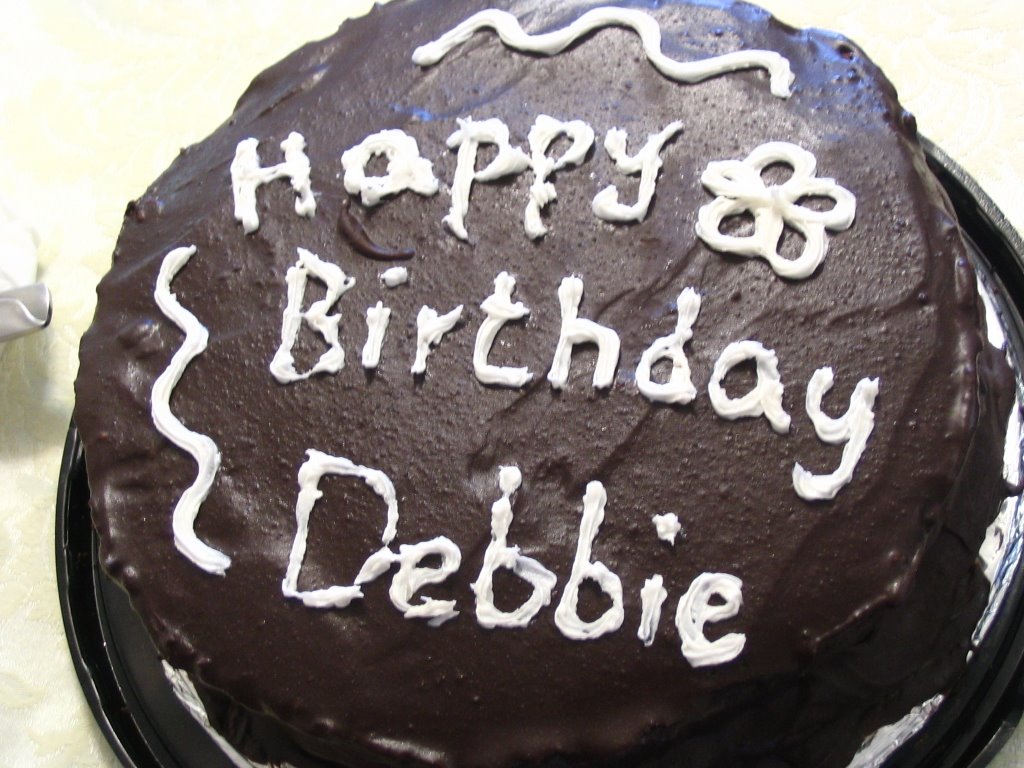 I will post the recipe in a next post, because it was delicious.
But my cake was like one drop in the bucket of baked goods that Debbie prepared :)
She made 4 chocolate pies, 1 pumpkin pie, 1 coconut pie, and 1 peacan pie. :) :)
I'll show here a piece of the peacan pie: 'Peacans' sono delle noci simili alle nostre noci, ma di forma piu' allungata e piu' piccole e gustose. Questo pie e' praticamente solo fatto con queste noci e sciroppo di glucosio. Io riesco a mangiarne solo una piccola fettina per volta, dato che e' ovviamente molto dolce, ma e' molto buono.. :)
She also baked about 200 mini-muffins: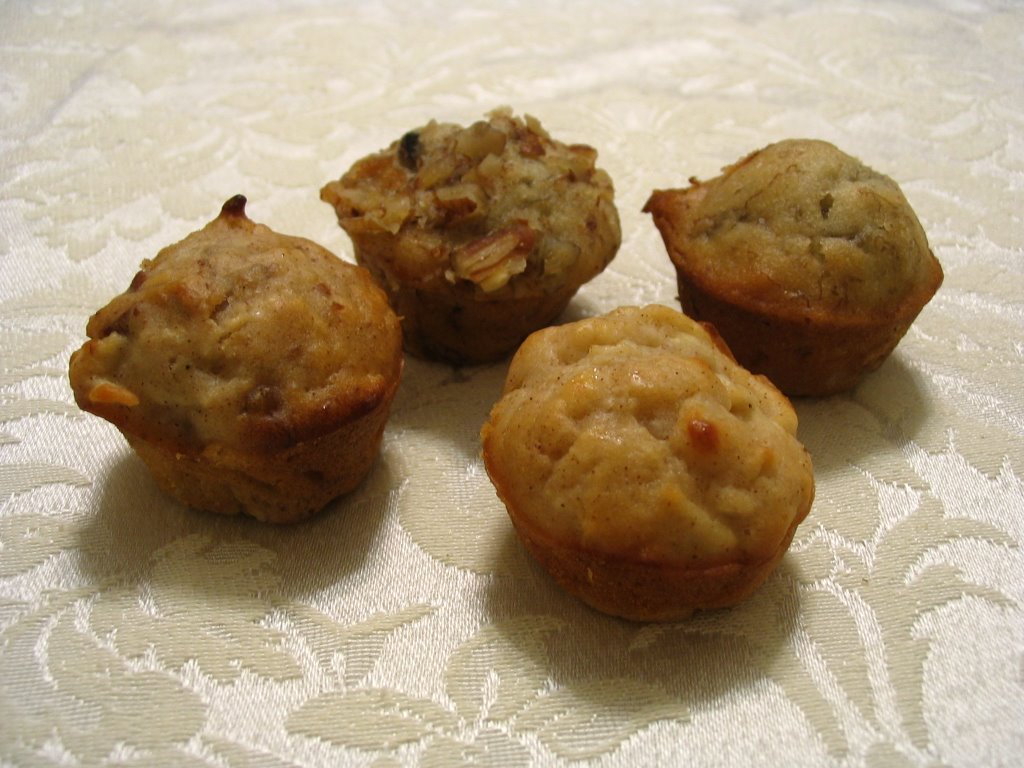 You can see here the banana-nuts, banana, apple, and apple-nuts muffins (from top, clockwise).. hard to decide what's the best. :)
And also, she baked about 200 sausage balls: Per i miei amici italiani che si chiedevano cosa fossero: sono davvero chiamate sausage balls, e sono fatte con salsiccia (macinata, stile americano) e biscuik (farina e lievito, praticamente), e passate al forno. I find it interesting that these are supposedly a breakfast food :) - I like them very much, but I can't have them early in the morning :) - I can't have bacon and eggs either, though, so I'm a bad example :)
I decided I'll speak about the non-food related Thanksgiving activities in another post.